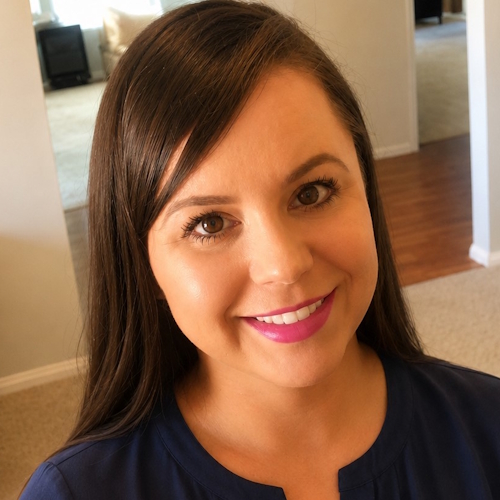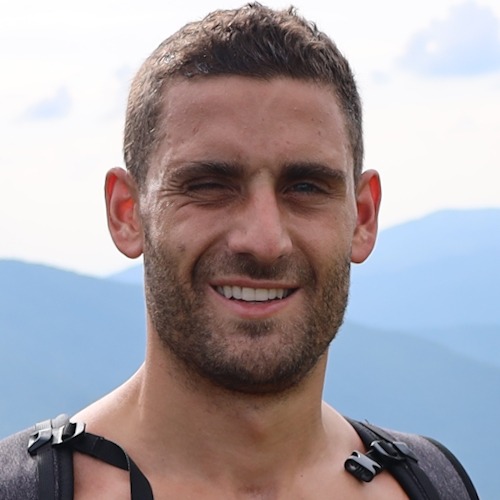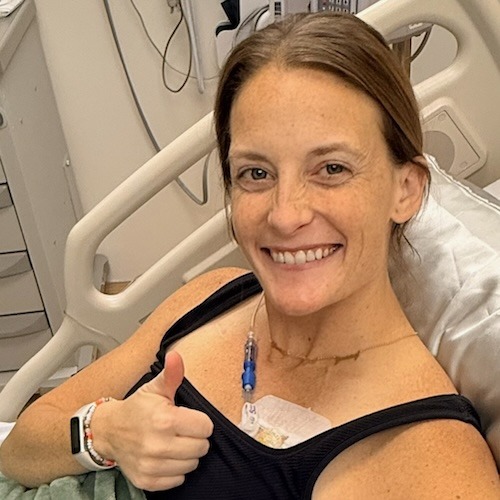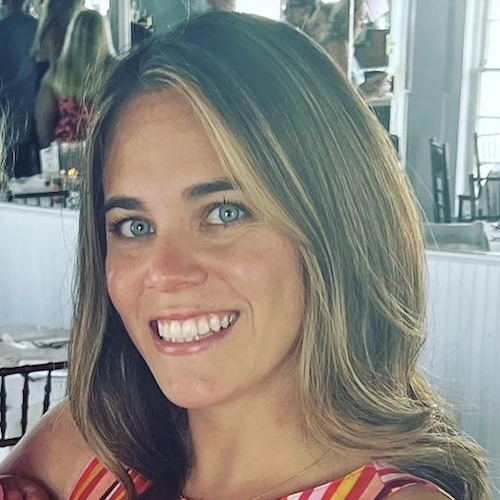
The Latest Research on ALK-Positive Lung Cancer
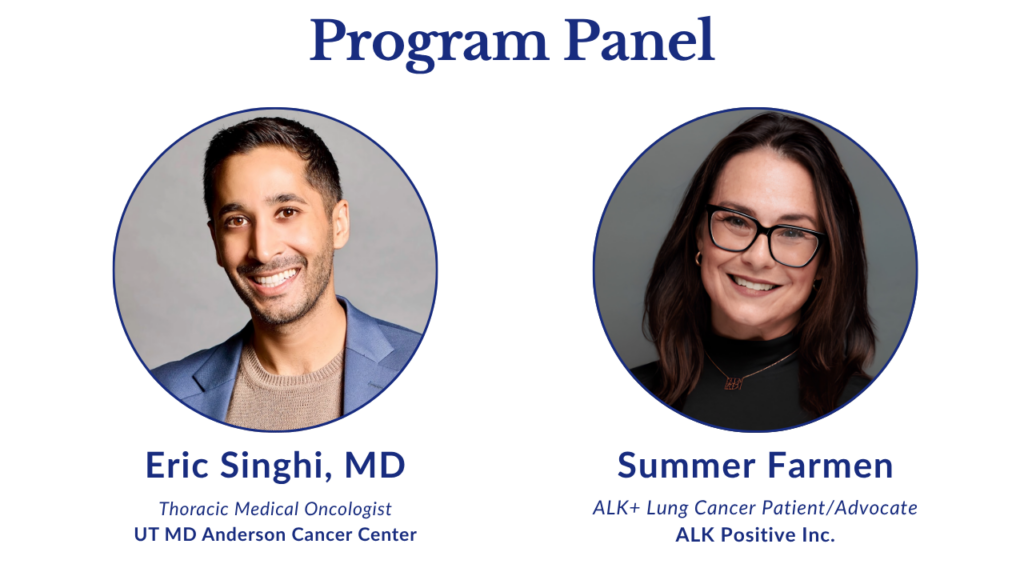
Medical expert Q&A featuring: Dr. Eric Singhi | Thoracic Medical Oncologist, UT MD Anderson Cancer Center | Updated August 19, 2026
New data is helping redefine what long-term disease control can look like in ALK+ lung cancer and what the research means for patients.
A lung cancer specialist breaks down the most significant ALK+ treatment news of 2026 and what it means for your next oncologist appointment. Plus, listen as ALK Positive’s own Summer Farmen shares her personal story, how it led to work in lung cancer advocacy, and some of the great resources ALKPositive.org has to offer patients.
Watch a replay on demand now or August 5th with live chat support.
In this free program, Dr. Eric Singhi of UT MD Anderson Cancer Center in Texas translates three major research updates from ASCO 2026 (the world’s largest cancer conference) into plain language, practical questions, and real answers about ALK-positive lung cancer treatment.
We also include Summer Farmen, ALK+ lung cancer patient advocate and Vice President of ALK Positive Inc. She shares her own story, her unexpected family connection to ALK+ research, what family and community mean, what the latest research means and why we need to keep pushing.
Program Topics
- ALK-positive lung cancer updates:
- CROWN trial 7-year data: Learn why some researchers and oncologists are calling this “the most significant ALK+ NSCLC result in years,” with more than half of patients on a specific targeted therapy having not seen their disease progress at seven years of follow-up, with the median still not reached
- LORIN Study: testing whether a specific targeted therapy given before surgery can shrink or eliminate stage III tumors
- ALKOVE-1 study: early data on an investigational new drug designed specifically for patients whose disease has progressed
- Listen to experts discuss:
- The full ALK+ treatment picture: Walk through how the three generations of ALK inhibitors differ, how oncologists now choose between them, and what happens if a first treatment stops working
- What to do about side effects being on long-term therapy
- Dose Reductions: Dr. Singhi explains why dose reductions (lowering your medication amount) are a real strategy, not a sign that treatment is failing
- Working with your medical team and making informed decisions together
Program Partner
Thank you to ALK Positive for their partnership. Learn more about ALK Positive’s patient support, educational resources, peer mentoring, and clinical trial programs. ALK Positive is a global patient-driven nonprofit dedicated exclusively to improving the lives and outcomes of people living with ALK-positive cancer through research, education, advocacy, and peer support.
Program Sponsor

Thank you to our sponsor for their support of our independent patient education program. The Patient Story retains full editorial control over all content.
This is not medical advice. Please consult with your healthcare provider to make informed treatment decisions.
- Introduction
- What makes ALK-positive lung cancer distinct?
- Meet Summer Farmen, ALK+ Lung Cancer Patient, getting tested, and the wait for an answer
- The ASCO 2026 headline: CROWN trial 7-year update
- The other 50%: An honest look at unmet need
- Dose reduction: Finding the right dose, not just the highest
- Navigating the ALK inhibitor generations
- When a treatment stops working: Questions to ask
- Informed decision-making and shared decision-making
- The LORIN study: Treating earlier-stage disease
- What happens if current treatments stop working?
- Clinical trials: An active option, not a last resort
- Living well: Finding community and quality of life on long-term targeted therapy
- Key takeaways
- Conclusion
- Hear from people living with ALK-positive lung cancer
Introduction
Stephanie: Hi, everyone, and welcome to this conversation, “The Latest Research on ALK-Positive Lung Cancer: New Long-Term Data Providing Real Hope.” My name is Stephanie Chuang. I’m a cancer patient advocate, survivor, and founder of The Patient Story. Our mission is to help spread the word so that you know that you’re not alone and to empower yourselves by advocating for what you want, which is very relevant all the time, especially after something like ASCO. It’s the biggest oncology conference in the entire world where there’s a gathering and sharing of the latest in research and this conversation is all about the impact of this research for the ALK-positive lung cancer patient community.
Before we get started, we want to thank Pfizer for its support of this educational patient program. The support helps us to bring more of this type of conversation out to you, so thank you to Pfizer. It is important to note that The Patient Story retains full editorial control.
We also want to thank our partner who is helping to promote this, ALK Positive, Inc. If you don’t know already, ALK Positive is a global, patient-driven nonprofit dedicated exclusively to improving the lives and outcomes of people who are living with ALK-positive lung cancer. This is happening through research, support of research, education, advocacy, and peer support, which we know is incredibly important.
We want to remind you that everything here is for educational purposes. It’s informational and not a substitute for medical advice or conversations with your care team.
We do a lot of educational programming. It’s important for us to know what we’re doing right, but more importantly, what we could do better, so we want to hear from you.
Jill Feldman
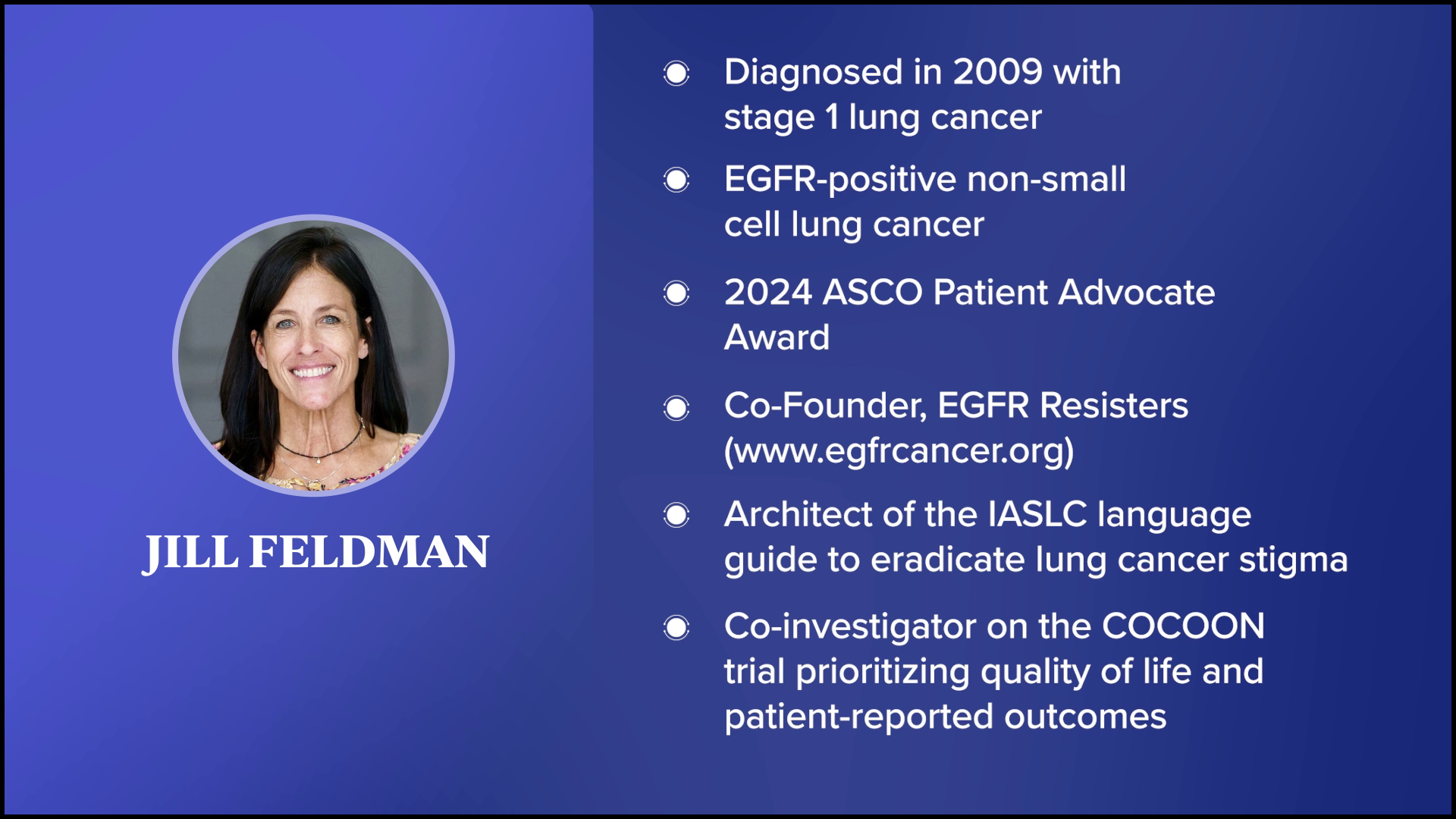
Stephanie: We’re excited to talk about our panelists for this conversation. We have Jill Feldman, someone I’m happy to call a friend. Jill was diagnosed with non-small cell lung cancer in 2009 and has been a patient advocate even before then. She was an advocate for her family members who were also diagnosed with lung cancer. She was awarded the 2024 ASCO Patient Advocate Award and is the co-founder of EGFR Resisters.
Beyond biomarkers, Jill is passionate about lung cancer patient advocacy overall. She helped architect the International Association for the Study of Lung Cancer’s Language Guide to eradicate lung cancer stigma. She’s also been a co-investigator on the COCOON trial, which prioritized quality of life and patient-reported outcomes.
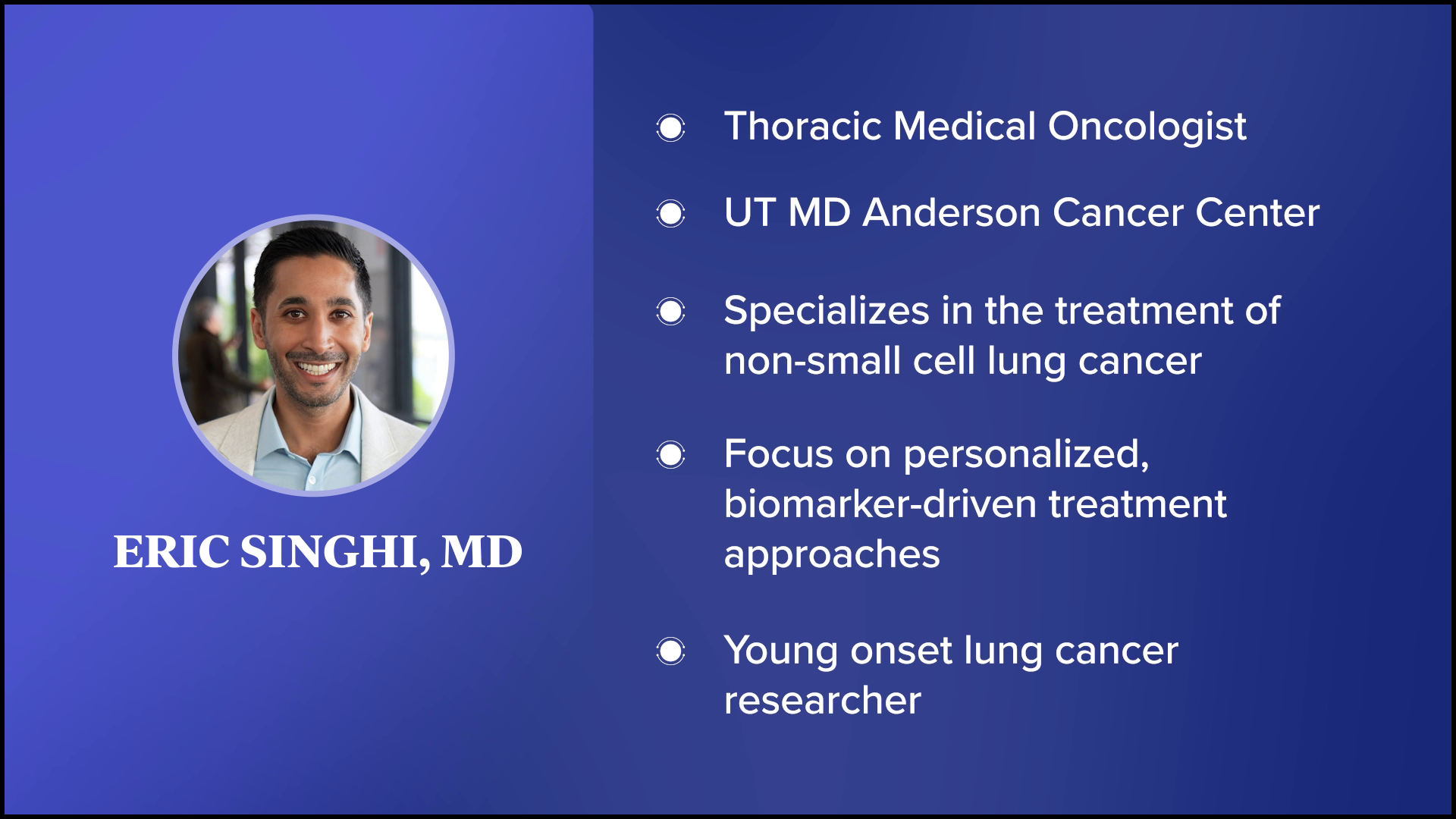
Dr. Eric Singhi
Stephanie: Somebody else who’s become a friend of The Patient Story and is a friend of Jill’s is Dr. Eric Singhi, a thoracic medical oncologist and a top lung cancer specialist at UT MD Anderson Cancer Center. Not only does Dr. Singhi specialize in the treatment of non-small cell lung cancer, but he focuses on personalized, biomarker-driven treatment approaches. Among many other bullets that we could put up, Dr. Singhi co-leads the Young-Onset Lung Cancer Program at UT MD Anderson. Lots to say to describe these incredible advocates, but I’m going to send it over to Jill to start the conversation.
Jill Feldman: Thank you, Stephanie. Welcome, everyone. I’m Jill Feldman, a lung cancer patient and advocate and we’re so glad to have you with us.
When I first got involved in advocacy, I never imagined I would become a research advocate, but when you’re living with cancer, research becomes a lifeline. Every new study represents hope and options; sometimes more questions than answers, but questions that matter.
We’re going to focus on ALK-positive non-small cell lung cancer and some of the most exciting and important research that was presented at ASCO 2026. I am absolutely thrilled to be joined by Dr. Eric Singhi. He is a thoracic medical oncologist who specializes in biomarker-driven lung cancer, and he leads the UT MD Anderson Young-Onset Lung Cancer Program. He’s also a dear friend I’ve known since he was a fellow and we’re so fortunate to have him here to help us understand what these new data mean. Dr. Singhi, should I call you Dr. Singhi or Eric?
Dr. Eric Singhi: Oh, please, Eric. We’ve been friends first.
Jill: Welcome.
Dr. Singhi: Thank you. I’m excited to be here with you. I always love unpacking all the updates from ASCO. It’s my favorite time of the year.
Jill: I know, right? Before we dive into everything, I’ll give you a quick preview of what we’re going to cover and what Eric’s going to explain to us.
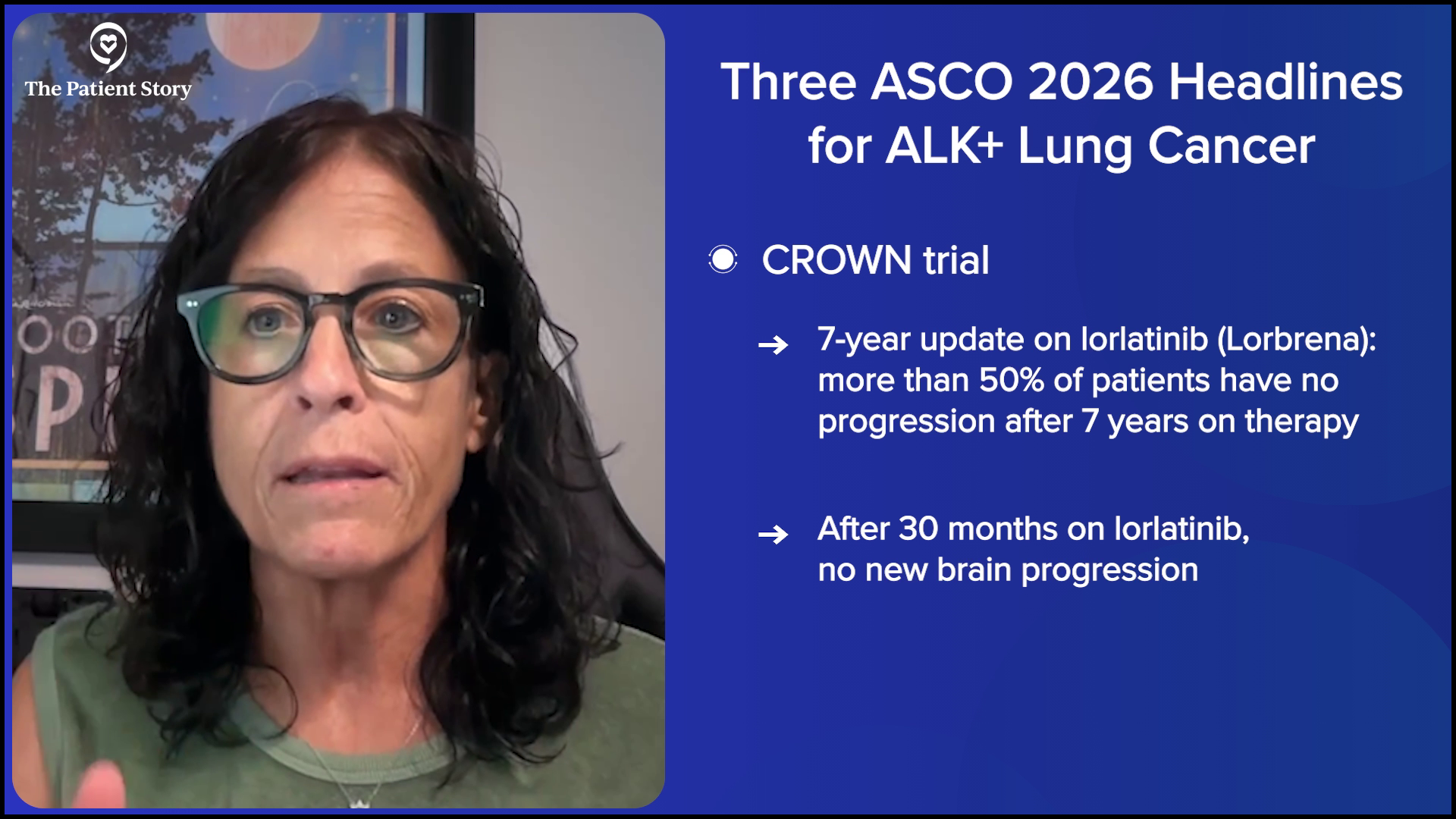
There are three different exciting developments whose data were presented at ASCO this year. First is the CROWN trial data, which was a study with people on lorlatinib (Lorbrena) versus crizotinib (Xalkori), where they gave the 7-year update. This trial is the story of durability. More than half of patients on lorlatinib still haven’t had progression at seven years, so that means that the median hasn’t been reached. It is mind-blowing and so exciting. After 30 months on lorlatinib, there was no new brain progression either. This is about the drug working, working well, and working longer, and for ALK patients, that is absolutely huge.
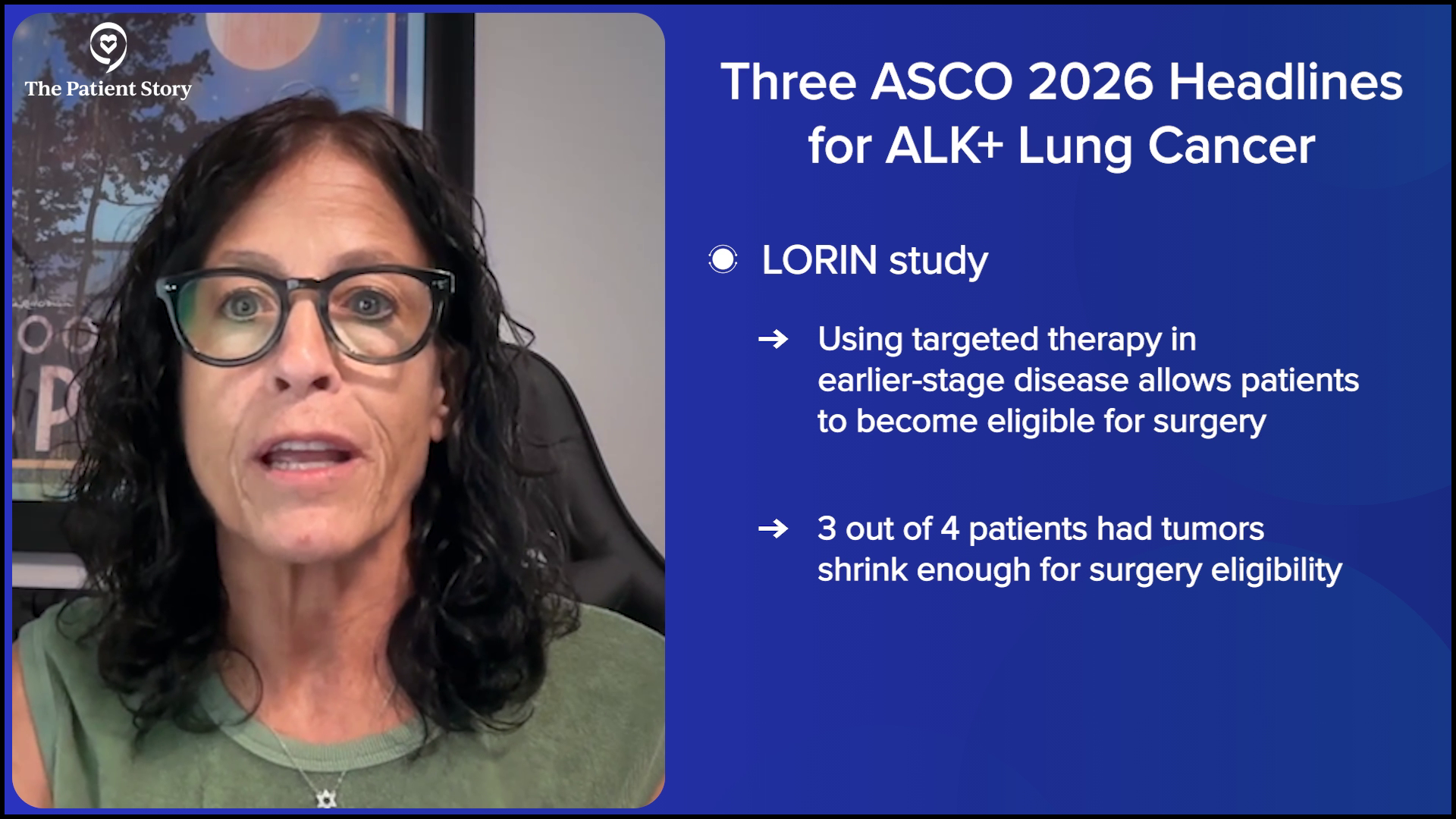
We also will talk about the LORIN study, which is looking at whether lorlatinib can be used before surgery for some people with early-stage disease. It was used before surgery in stage 3 disease in people who were originally considered inoperable. In this study, three out of four patients became eligible for surgery. We are seeing treatments that changed advanced-stage disease now being tested in earlier-stage disease and working well, especially in the surgery setting.
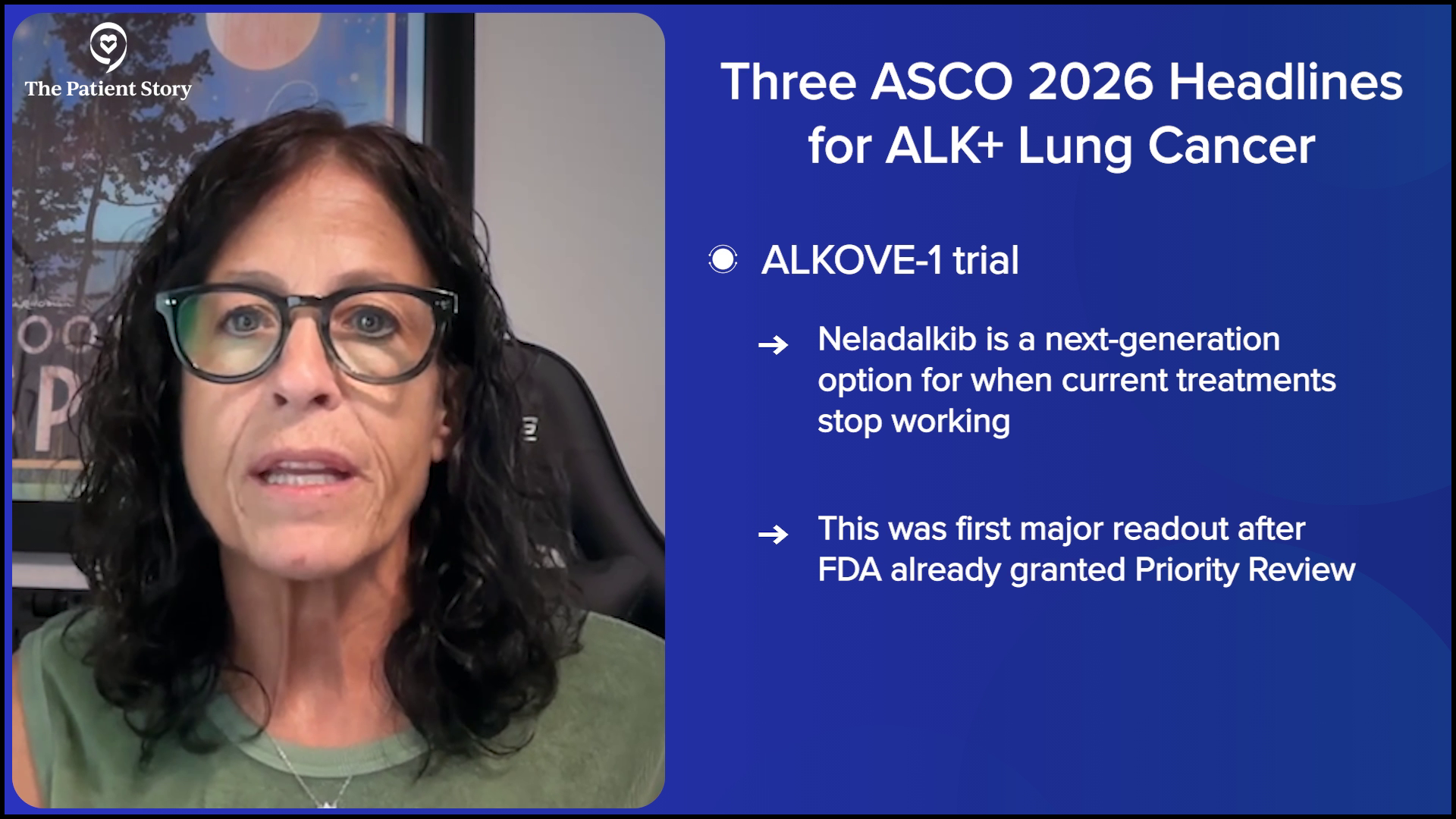
Finally, we’ll discuss ALKOVE-1. This is the next-generation story because it’s the next-generation drug that’s designed specifically for people whose cancer develops resistance to the current ALK inhibitors, including lorlatinib. They gave their first major readout at ASCO 2026 and the FDA has already granted Priority Review.
What makes ALK-positive lung cancer distinct?
Jill: That’s a lot to cover. Eric, can you first walk us through what makes ALK distinct and why that matters?
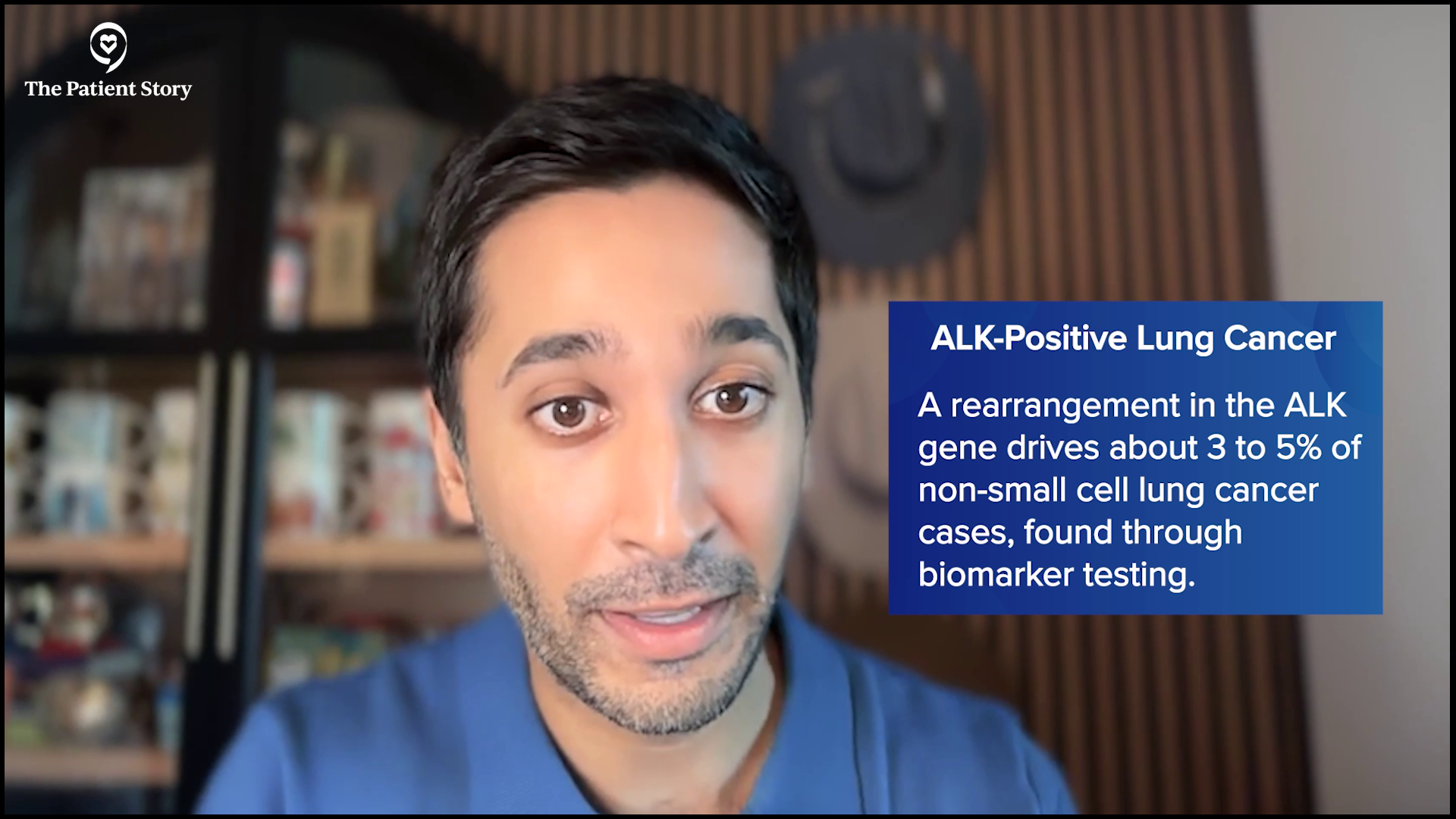
Dr. Singhi: That’s a great question. To set the stage, ALK-positive lung cancer happens in about 3 to 5% of patients with non-small cell lung cancer in the stage 4 setting. But you’ve hinted, Jill, very appropriately, that we need to be testing all patients, regardless of their stage of disease.
Understanding the biology, the fingerprint, or the blueprint of the tumor from stage 1 all the way to stage 4 is incredibly important because we’re making advancements for patients across the spectrum. But ALK happens in roughly 3 to 5%, so it’s not a very common fusion, but a very meaningful one.
These patients don’t fit the typical median age or the profile that we think about for patients with lung cancer. These tend to be patients who are younger with no smoking history and who are in the prime of their lives, so you need to think about patients who don’t fit that typical profile.
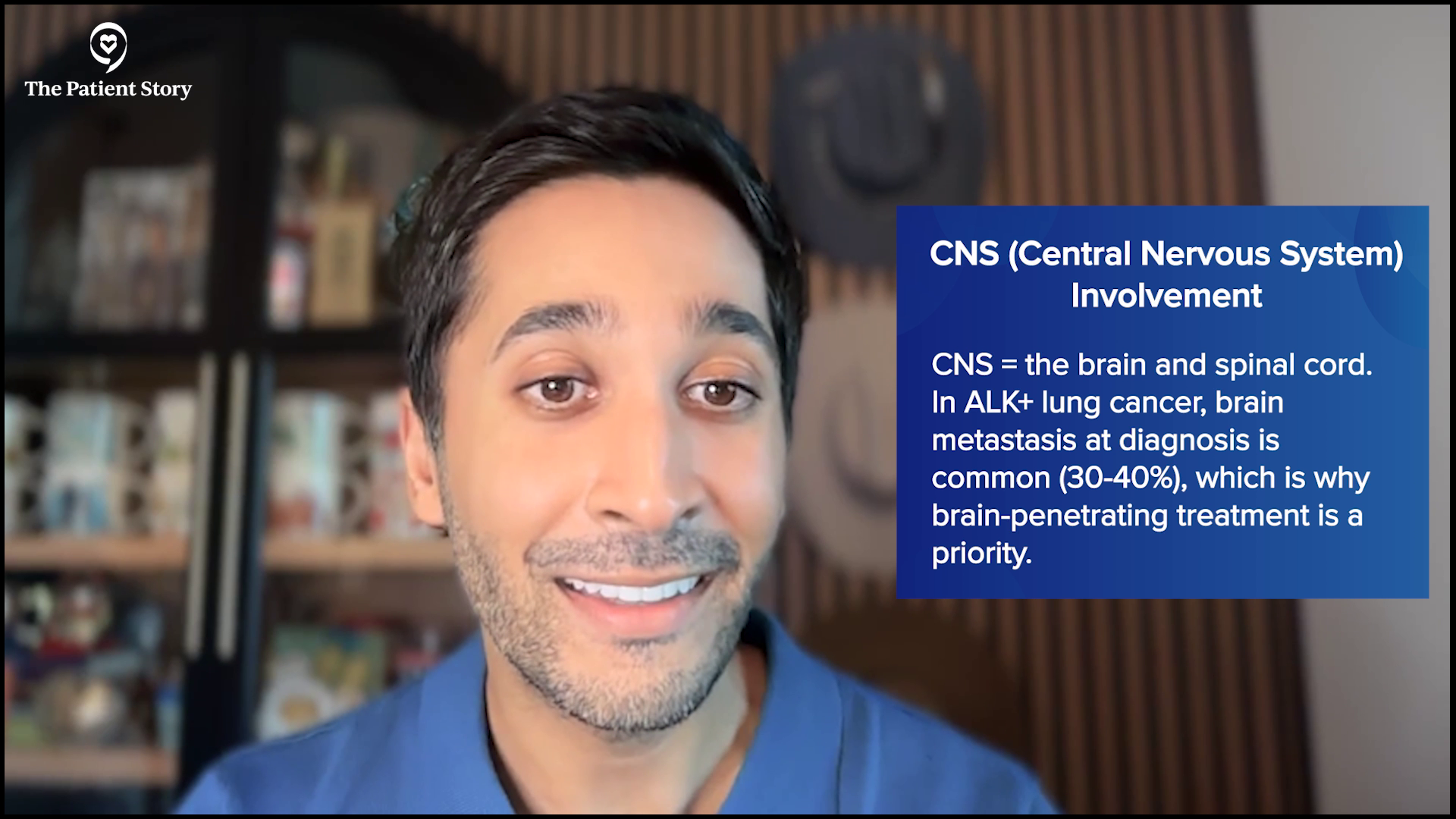
Another aspect of ALK fusion-positive non-small cell lung cancer is that, unfortunately, there’s a high incidence of CNS or brain involvement. Even from the beginning, almost 30 to 40% of patients with non-small cell lung cancer that is ALK-driven will have a brain metastasis at their first diagnosis. That’s to set the stage in the landscape of what ALK disease is, why biologically it’s different, and why it presents differently in the clinic.
Meet Summer Farmen, ALK+ Lung Cancer Patient, getting tested, and the wait for an answer
Stephanie: Now, it’s so amazing to hear from Jill and Dr. Singhi. Thank you both so much. We’re going to continue that conversation, but, as everyone knows, it’s also so important to highlight the patient voice through all this — in this case, people who have been dealing with and living with ALK-positive lung cancer.
We want to highlight the great work being done by the groups dedicated to helping patients, so The Patient Story has partnered with ALK Positive Inc. and you’re going to hear directly from their vice president, Summer Farmen, throughout this conversation. Summer is going to share her path to her ALK-positive diagnosis. She talks about biomarker testing and an unexpected family connection to ALK-positive lung cancer research.
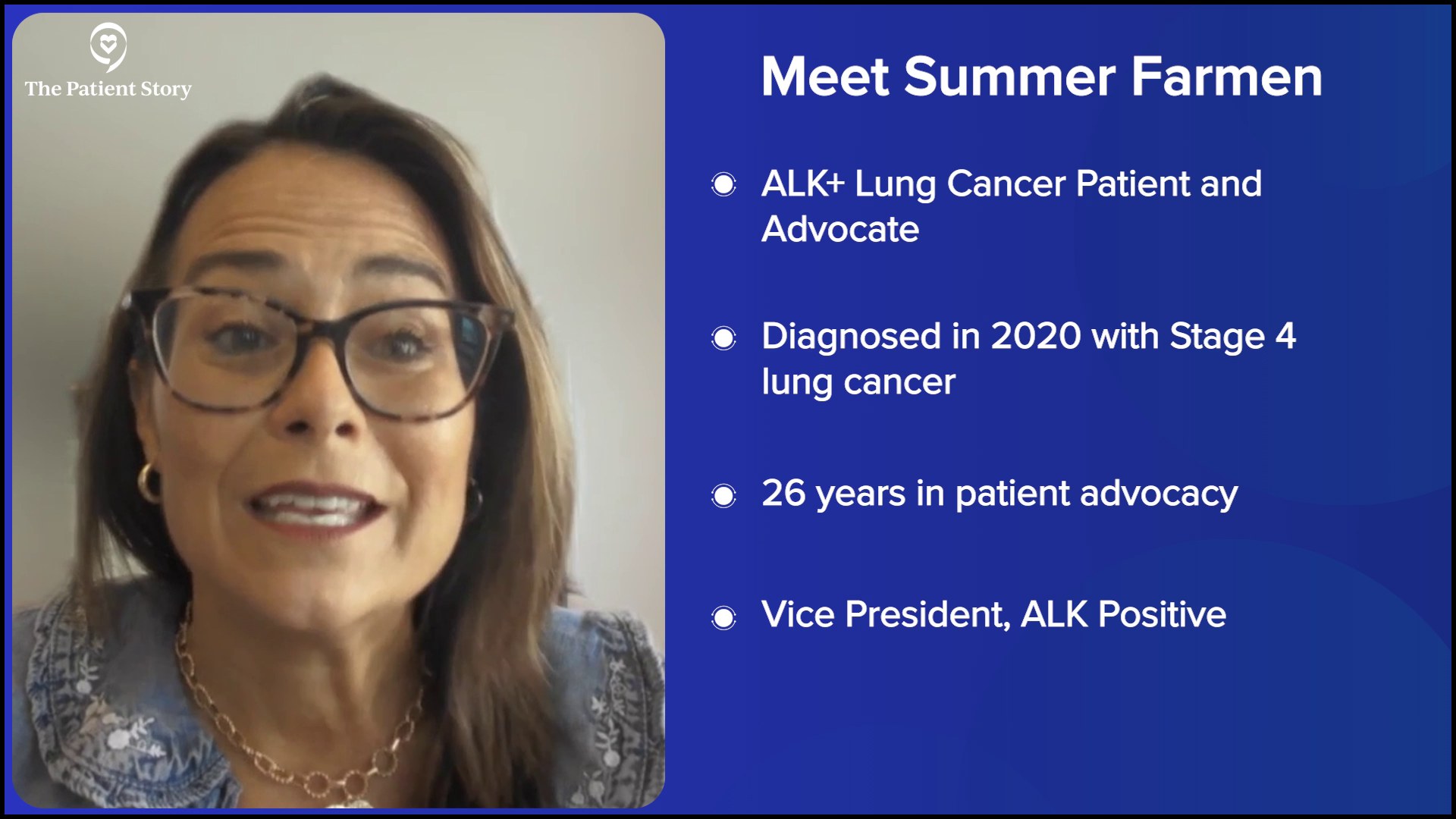
Summer Farmen: Hi, I’m Summer Farmen. I celebrated my 50th birthday, one that, six years ago, I never thought that I would see. I also never thought I would be so excited to turn 50 as a girl who always dreaded age, but it is definitely something that I have celebrated and embraced.
I became a patient advocate at 24 years old when my twin boys were born four months premature at a pound and a half each. One became our family’s guardian angel after three days, and the other had a long and rocky five-month NICU stay. He was given a 5% chance of survival, but we brought him home five months after he was born.
My husband and I had been married for a year. We were young parents and here we were, thrust into the life of new parenthood and parenting a child with complex needs. We always wanted a family, so a few years after having Jackson, we had Lucy. Then we took a little break and had Harrison.
By trade, I’m a special educator, so it was always like, which came first: the chicken or the egg? I’m always working with families through their diagnoses and helping them get on the right path. I also quickly learned with Jackson about the importance of having a strong care team, a care team that you are making shared decisions with, and the importance of getting a second opinion.
My symptoms started with a cough
Summer: It’s the COVID pandemic. We’re all quarantining. I developed a cough that was first treated as pneumonia. Everybody’s doing telehealth. From there, things progressed and escalated. I found myself in the emergency room alone, texting my children and my parents as we tried to figure out what was wrong with the mother who has never needed any help.
I thought, “Could I have COVID? It doesn’t make sense.” I stayed in good shape so that I could be the best mom to Jackson and my kids, so I never smoked. I didn’t have risk factors for lung cancer, let alone cancer at all. Cancer was definitely not on my radar.
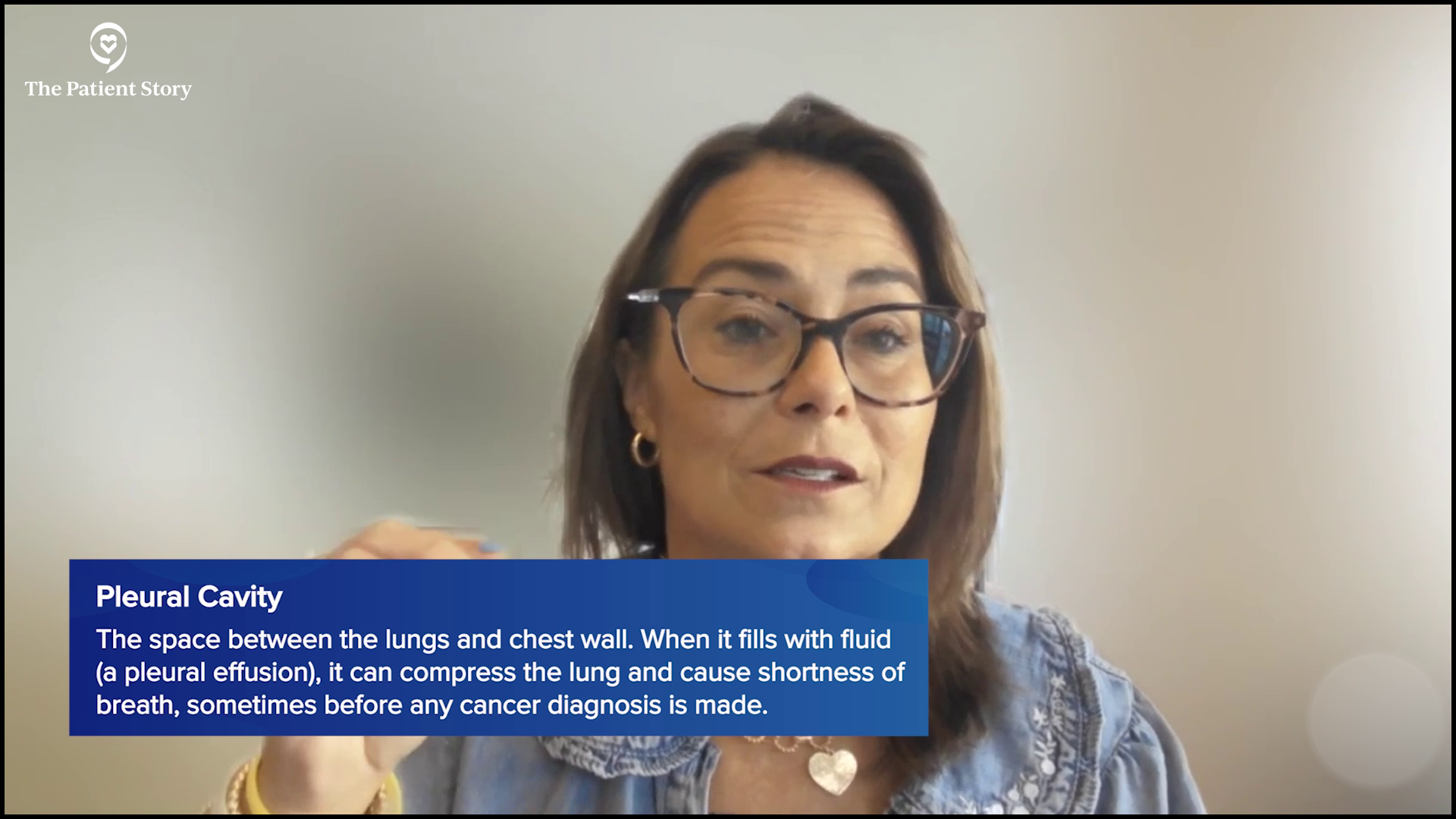
I found out that my right lung was completely smushed. The pleural cavity was filled with fluid, so it made sense why I couldn’t breathe because essentially, I had no air movement there. There were two liters of fluid crushing that lung. They rescanned me, then a pulmonologist came in and started talking about the scans and that there were tumors.
Biomarker testing, the biopsy wait, and an unexpected family tie
Summer: I grew up with a father who had a career in the oncology space. He worked on the development of clinical trials. Plot twist: He actually worked on one of the first ALK inhibitors, so we talked about cancer at the dinner table the same way a mechanics family would talk about cars.
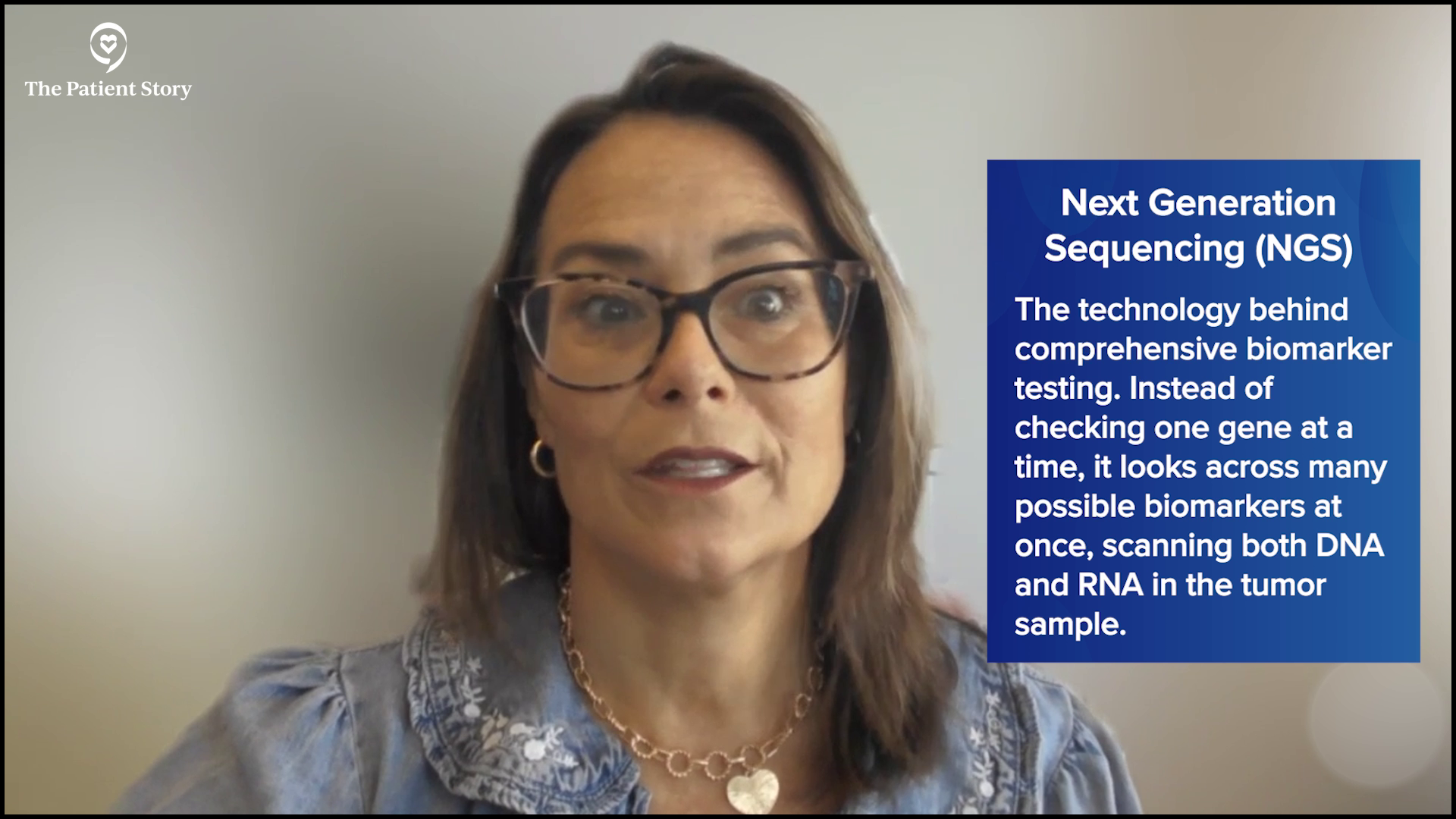
I knew what a biopsy was, but not biomarker testing. The pulmonologist started explaining next-generation sequencing and biomarker testing. I’ve become quite a champion for next-generation sequencing and biomarker testing because I was so fortunate to have all of this information in place and people advocating for me.
Dr. Singhi: When I hear a story like this, my first reaction isn’t to think about the scans or medications, but to validate and recognize how profoundly unfair this is, right? This should be a moment of celebration in this person’s life is the first thing that I would say.
The second thing that I would stress is that I commend the oncologist for finding and doing biomarker testing to identify this ALK fusion. I tell my patients in the clinic, “I don’t just want to treat lung cancer; I want to treat your lung cancer.” And this is not something theoretical. This is truly clinical because this is an opportunity to give patients very precise medicine that can hopefully last for years.
One of the hardest parts of cancer care is not always the treatment itself. It’s in the beginning when you’re waiting to get those biomarker testing results because it can take two or even three weeks. I want to stress that the wait can be absolutely worth it. If we find a biomarker, it allows your oncology team to deliver very precise medication that can work very well, hopefully with minimal toxicity, and hopefully for a very long time.
There’s a lot of behind-the-scenes work happening from the very beginning, which involves ideally trying to find a biomarker to personalize your treatment, to give you very long-term outcomes that are meaningful. During that wait, what you can do as a patient is to focus on your mental health, prioritizing your physical health, and writing down any questions that you have for your team. Utilize that wait to your advantage to get stronger from a mental standpoint, from a physical standpoint, and to get ready to get started on your treatment.
Jill: That’s a great point. I always remind people that lung cancer isn’t one disease. Once you know whether or not you have a biomarker, the entire conversation changes. It’s no longer what treatment am I going to get; it’s what treatment works in my situation. How long the treatment works changes. In talking about data, it’s more about what it means for the type of lung cancer I have. That’s exactly why we’re here today, not just to talk about the science, which is the exciting part, but importantly, what it means for people diagnosed with ALK-positive lung cancer and their families.
The ASCO 2026 headline: CROWN trial 7-year update
Jill: Eric, can you walk us through the CROWN trial data?
Dr. Singhi: If I had to summarize the biggest ALK story from ASCO 2026 in one sentence, it would be: We now have some of the longest and most durable targeted therapy data sets ever to be reported in metastatic lung cancer. I take that back. It’s not even metastatic lung cancer; it’s all solid tumors, which is an incredible story of durability. I was just as excited as you were.
Jill: I want to point out: all solid tumors.
Dr. Singhi: Yeah, stage 4, all solid tumors. It’s incredible to have information like this. We first heard the 5-year update two years ago at ASCO. I remember being in that room and having chills seeing the curves. Then we heard that the 7-year update was coming back to ASCO. The more long-term data we get tells us that patients are still doing well and that there’s still hope and that there’s still durability. We need to care not only about those initial response rates, but about preserving patients’ quality of life, making sure that, like you say all the time, they’re truly not just surviving, but living, right? An emphasis on that.
Jill: What are some of the key factors besides not having over 50% of people not progressing? Is there any other data presented that was mind-blowing? Any sub analysis?
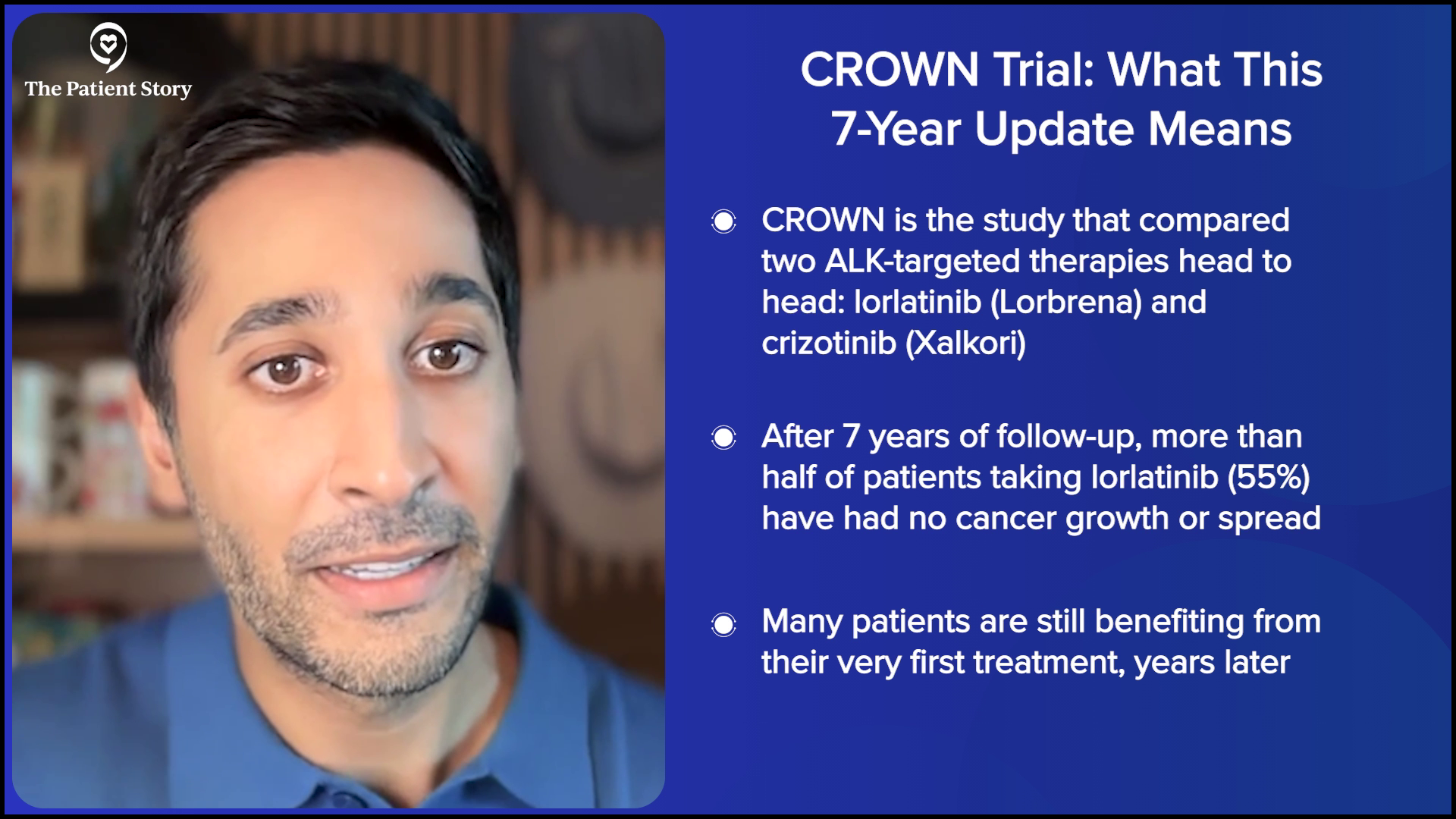
Dr. Singhi: Yeah, absolutely. The first thing we’ll highlight is we learned that median progression-free survival was not reached. What does that mean when people hear that? A lot of people think, “Oh my gosh, information is missing.” But I’ll challenge you to rethink that.
What that means is one of the best things that we can report: More than half of the patients are still benefiting on their first treatment, which is a pill that they take at home. This is incredible and unheard of to see it this long and this far out. Again, 55% of patients remained progression-free at the 7-year mark, which is unheard of in this space.
If patients were still doing well at two years, if they did not have any evidence of cancer growth on first-line lorlatinib, there was nearly an 80% chance that they were still going to be progression-free many years later.
Dr. Eric Singhi, Lung Cancer Specialist
The second point that I took away from the presentation was this 2-year milestone and this is probably my favorite clinical pearl. It’s what I teach my fellows when they come through the clinics and make sure that all the community oncologists know about that. Patients don’t just want to know what’s going to happen tomorrow; they want to know what’s going to happen many months and many years from now. What can they hopefully expect?
One finding that stood out from this update was that if patients were still doing well at two years, if they did not have any evidence of cancer growth on first-line lorlatinib, there was nearly an 80% chance that they were still going to be progression-free many years later. I think that’s very reassuring to be able to tell patients, right?
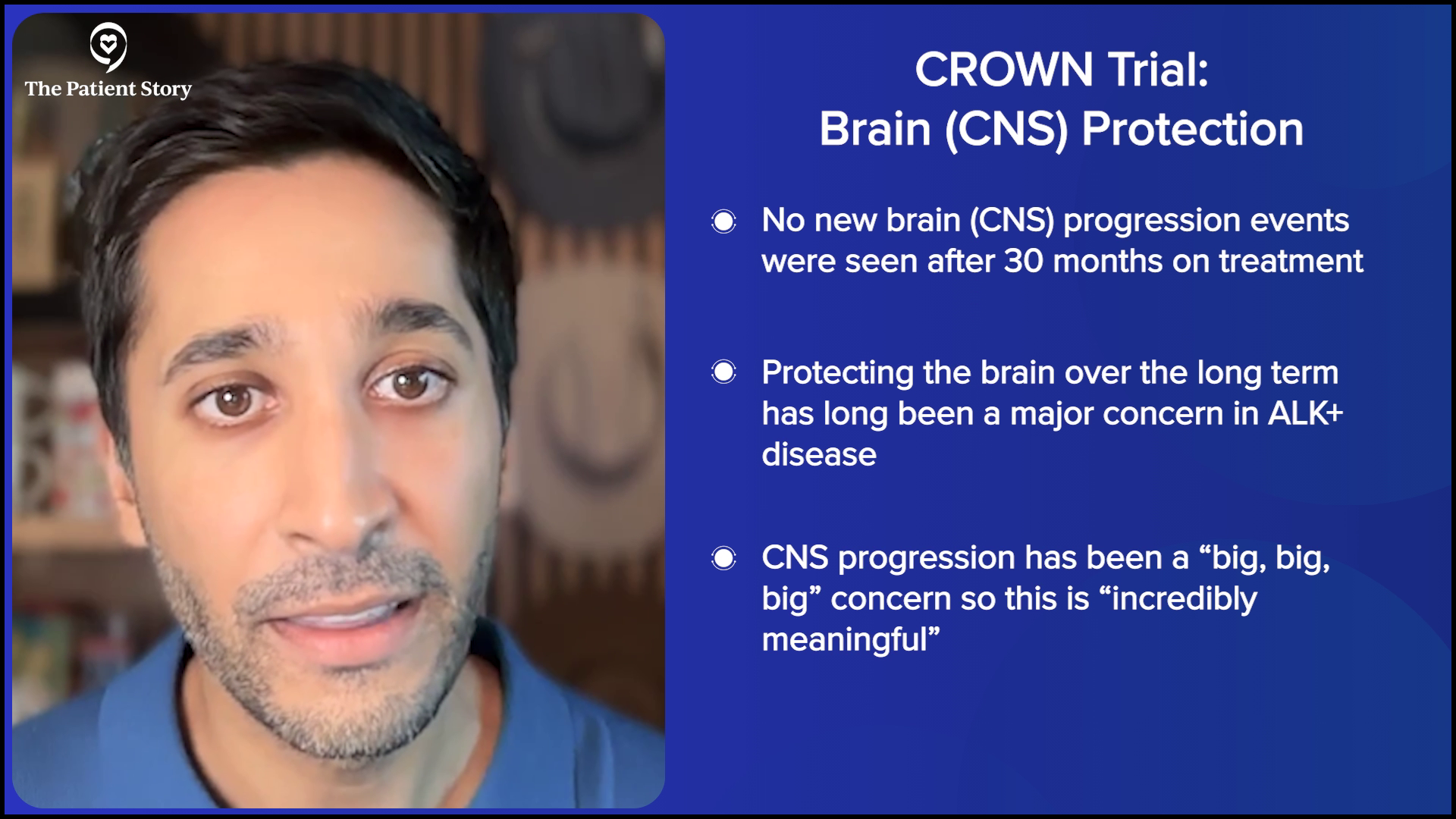
The third thing to emphasize was brain metastases. One of the things that impressed me wasn’t just how long patients lived without progression, but also where the cancer wasn’t progressing. You emphasized this in the overview that if patients were on lorlatinib and did not have any evidence of brain disease or growth of CNS metastases, two-and-a-half years at that milestone, then they did not see any more progression-free events in the brain. Wow. That is also something very unheard of.
For me, for patients, and for thoracic oncologists who have seen that ALK-positive disease have this tropism where it likes to go to the brain, this has always been a big, big, big, big concern and this is incredibly meaningful to see that protecting the brain is actually happening and it’s lasting for a while.
Summer’s view on the CROWN trial data: Real progress, real work left to do
Stephanie: Thank you, Dr. Singhi, for explaining some of the CROWN trial data and the update, but here’s also what it means to someone who’s living it. Summer sees real reason to celebrate this data, but she’s also going to tell you why the work isn’t finished, especially for patients who don’t respond the same way.
Summer: It’s so amazing to hear that when I was diagnosed, the median life expectancy was 7.5 years and now, we’re seeing that patients on first-line treatment can be at seven years and that’s just where they are. We’re not even sure beyond. We haven’t capped there. There’s still no progression. It’s also why our work can’t stop.
We went live from ASCO. ALKtALK is a Zoom session where the ALK community comes together and we bring in ALK experts from around the world so that the ALK community has the privilege of hearing this data firsthand. We went live with Dr. Christine Lovly and it was super cool because she could share her thoughts on the data right there from ASCO as it was all unfolding, so that was amazing.
At ALK Positive, we are so excited. I have many friends who are on this first-line treatment. However, I have many friends who didn’t start lorlatinib as their first line, so while it is amazing, there’s still so much work to be done because there’s a whole ‘nother population that didn’t start with that treatment.
Also, there are people who we call short responders who, for some reason, aren’t having those same results. We’re celebrating what this CROWN data is showing, but I know that oncologists, researchers, and clinicians all want to find out why this subset of patients isn’t responding. Why is their cancer progressing? That’s one thing we need to find out.
We also need to continue to push the envelope with different types of treatment for other patients who didn’t start with first-line lorlatinib. It also brings in the challenges of survivorship and long-term living. What a great problem to have, though, but it definitely is a problem. When you’re living seven years or more with ALK-positive cancer, your cancer’s evolving. You might start with certain side effects, which might go away or ebb and flow, then new ones present. There are different challenges to living longer. Again, phenomenal that we’re in this space, but it still leaves a lot on the table.
The other 50%: An honest look at unmet need
Jill: We keep talking about it being so exciting and amazing, but some people don’t have that experience. There’s the other 50%. What if somebody doesn’t have that experience? Can you put that into perspective? It’s hard. We need to celebrate progress, but also recognize the people whose experience is very different and don’t get the benefit that we’re so excited about.
Dr. Singhi: You’re absolutely right. When I posted information on my social media about how excited I was about ASCO, one of the comments I got from a patient advocacy group that I respect was, “I’m thinking about those patients who didn’t make it to that two-year milestone.” How exciting is it that if you can make it to the two-year milestone, you have an 80-plus percent chance of continuing to have that progression-free survival? What about those patients that don’t get there?
That is a huge unmet need that I’m continuing to challenge our field to delve into to better understand how to make sure that more patients are getting to that two-year milestone, so that they can get to year three, year four, year five — you name it. Whether they’re combination therapies, whether understanding from the get-go if certain resistance patterns are already present that we can better define, better understand, or better target. Yes, a huge area of unmet need and continued research.
Dose reduction: Finding the right dose, not just the highest
Jill: It’s important to know that we’re looking at research into why, because we can’t do anything about it until we know why. And you alluded to it earlier in my passion about living well.
One thing that stood out to me was the dose reduction information. As you know, I’m a huge proponent for dose reductions for patients where the treatment is difficult and isn’t tolerable. But many patients worry that lowering their dose means that the treatment isn’t going to work as well. I know it’s anecdotal, but over the years, I’ve seen across a lot of therapies that you can reduce the dose and, by doing so, it doesn’t impact the efficacy and helps people stay on treatment longer. How do you interpret these results? What do they mean for you clinically?
The goal isn’t necessarily to keep you on the highest dose; the goal is to keep you on the right dose.
Dr. Eric Singhi, Lung Cancer Specialist
Dr. Singhi: You’re absolutely right, Jill. One of the common questions I get asked in my clinic is: If we were to lower my dose, am I losing my chance of controlling the cancer? We want to have some reassurance to answer that question objectively for patients. This was a key takeaway from the CROWN 7-year update. What I’ve learned from this data is to tell patients that the goal isn’t necessarily to keep you on the highest dose; the goal is to keep you on the right dose. That’s the key takeaway.
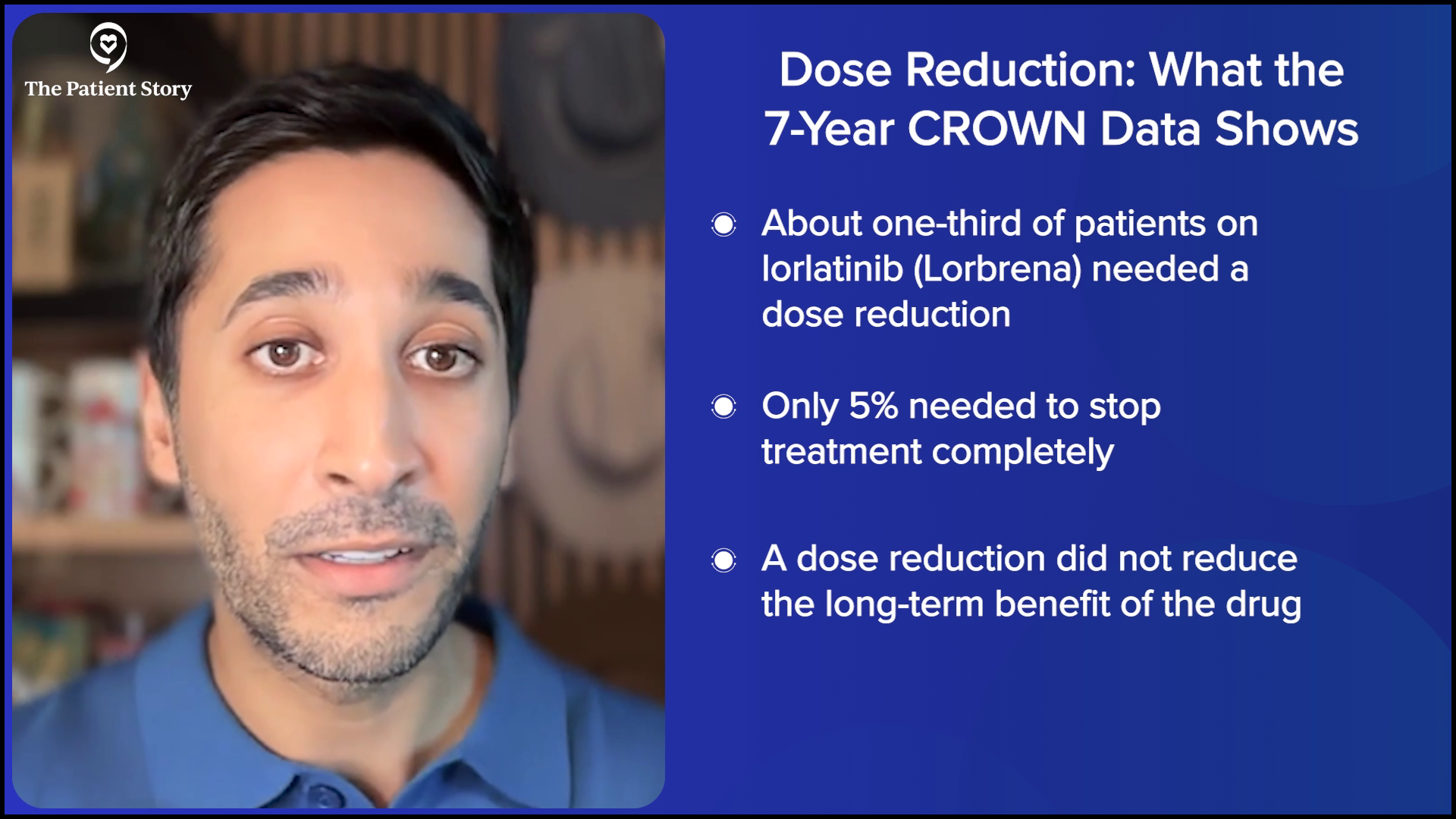
The data showed us a few things. About one-third of patients who are on lorlatinib in the front-line setting are going to need a dose reduction, so they’re not alone. If you need to make a dose reduction, almost a third of patients needed it, but only 5% of them had to completely stop treatment; very reassuring treatment discontinuation rates.
The most important thing was that even for patients who required a dose reduction, the long-term benefit of the drug was not reduced, so that’s a breath of reassurance for patients, families, and oncologists, which I appreciate.
Jill: Yes. We need oncologists to talk about that upfront, so patients aren’t afraid to talk about it with their oncologists. I think that’s key.
Navigating the ALK inhibitor generations
Jill: We covered the exciting CROWN data. Let’s take a step back. Can you talk about the big picture, navigating the ALK treatment landscape and what it means for patients?
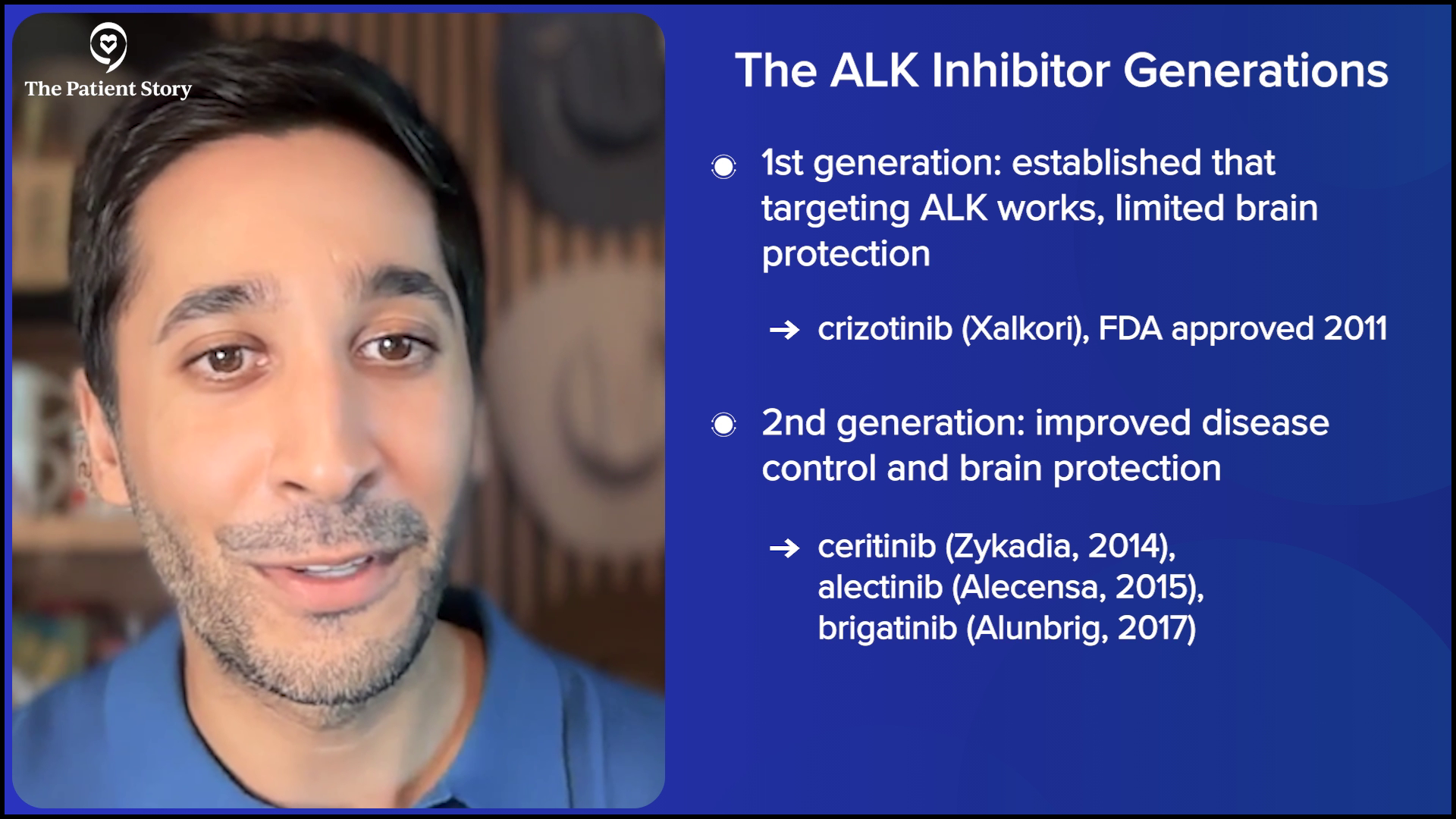
Dr. Singhi: One of the beautiful things about the ALK landscape is that we have options for patients — not just one singular option, but options — and that’s changed. That story has changed over the last 10 to 15 years. Initially, we had these first-generation oral targeted therapies. The one that we talked about is crizotinib (Xalkori). It worked, but it didn’t work for a very long time and it also did not protect the brain. Remember: Brain is a very common theme and concern that we worry about for patients with ALK fusion-positive non-small cell lung cancer.
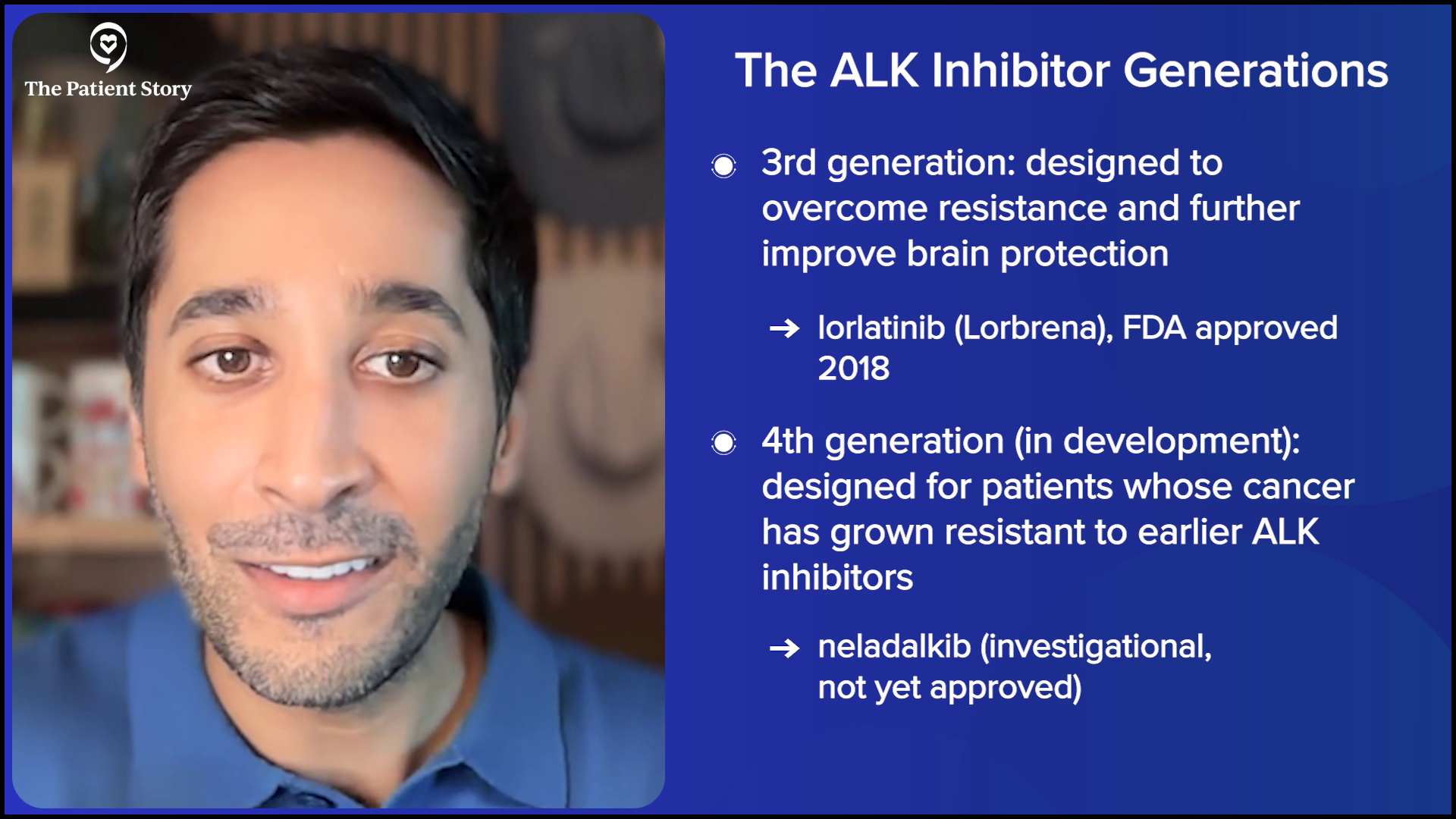
The way that I explain how we make progress in this field is through the iPhone analogy. We have the first-generation iPhone and the second-generation iPhone, and we keep trying to do better. What usually gets better for the iPhones is the camera quality and the battery life, right? We’re trying to do the same thing for these targeted therapies.
We’ve gone from generation one and we’re working our way up to now generation four, which is in active research right now. With these new additions, we’re getting better battery life, so that means hopefully better progression-free survival, right? We’re also getting better protection of the brain. That’s where this field has continued to evolve.
Jill: Wow. That’s amazing.
When a treatment stops working: Questions to ask
Jill: For someone who’s newly diagnosed or whose cancer has progressed and it may be time to switch treatments, what are the most important questions to ask your oncologist to understand why a certain treatment is being recommended over another treatment?
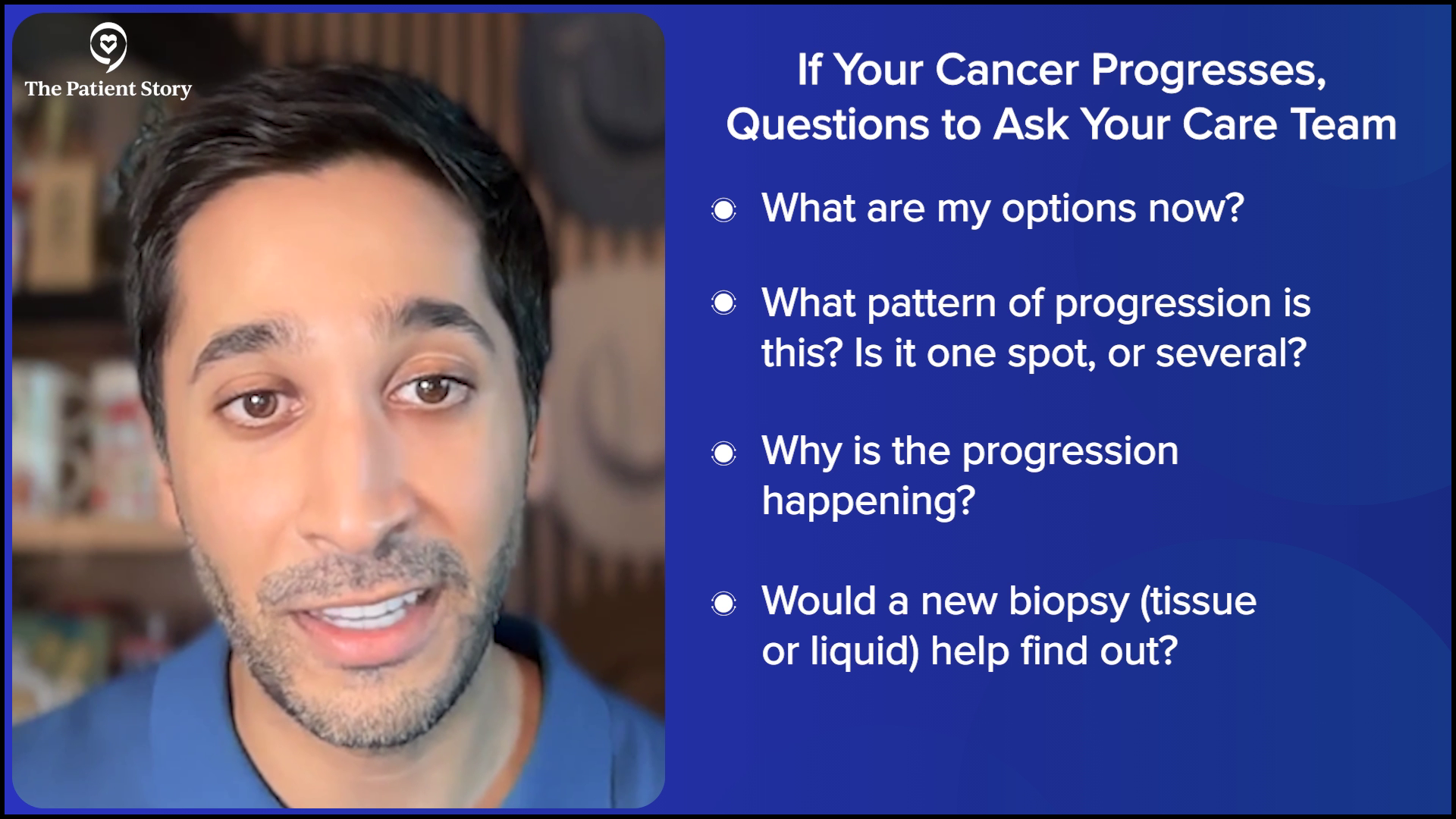
Dr. Singhi: Progression is a very scary experience for patients, families, and even oncologists. These are the hard conversations that we have in the clinic, including some of these numbers that I’m showing. We talked about median progression-free survival from the CROWN study, where patients are able to stay on the same therapy for seven years and their scans look good and the disease looks controlled.
But when progression happens, the first thing to stress is that often, it’s not the end of the road; it’s a fork in the road where hopefully we have multiple options that we can discuss, use informed and shared decision-making, which I know you’re a big proponent of, Jill.
The second thing is to understand what pattern of progression is happening. Is it multiple spots happening all at once? Is it one isolated spot? That can make you think about how to approach treating and managing this progression.
Then the third question is why. Why is the progression happening? We learned about understanding the biology of ALK fusion-driven non-small cell lung cancer in the beginning. You have to understand the biology again. Why is it happening? If there are opportunities to do biopsies — tissue biopsy, liquid biopsy — I would highly encourage discussing that with your team to understand the why.
Jill: That’s a great explanation of the different factors that go into a recommendation. I think that’s important to understand.
Informed decision-making and shared decision-making
Jill: I’m going to go back to shared decision-making for a minute though. I talk a lot about informed decision-making. Patients need to be informed. They need the information that they can actually understand. You and I have done work together in that area. They need that information before they can participate in shared decision-making. As an oncologist, how do those concepts work together? Knowing that would help patients with approaching those conversations.
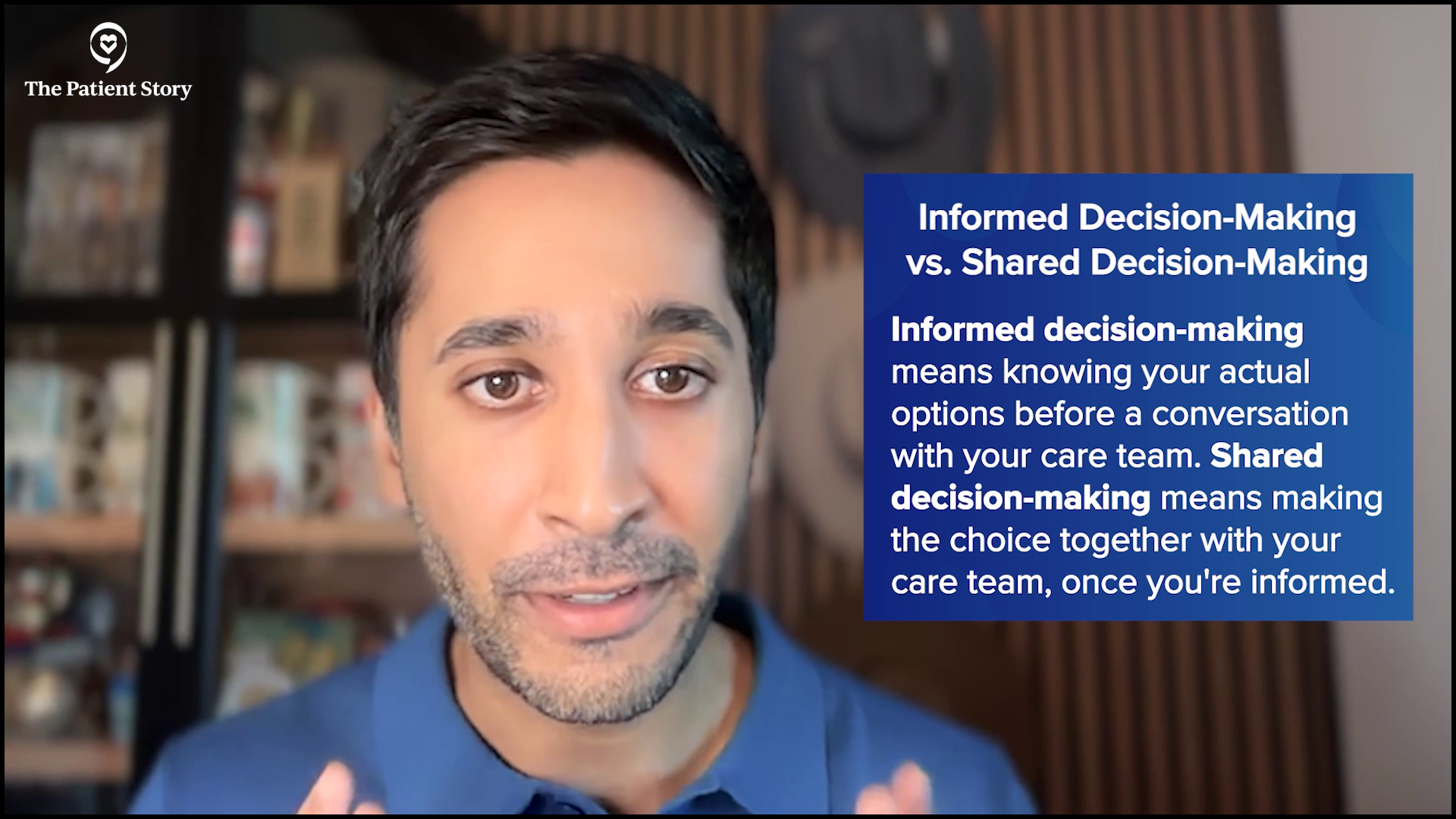
Dr. Singhi: You’re the one who taught me about informed and shared decision-making, and how they have to work together. If patients don’t know the options, if they’re not informed, how can they engage in shared decision-making, right?
The first thing is making sure patients know what the options are. Every setting is very different with regard to resources that are available, so this is a call to action. We’ve talked about building these resources that people can access that are unbranded through patient advocacy groups and reputable organizations, and to do it not only on printed pieces of paper, but on social media and digital platforms, which is why we’re doing talks like this. Make it accessible; that’s one thing.
The second pearl that I give my trainees when they come into the clinic with me is to ask open-ended questions. That encourages bidirectional communication with patients and their families instead of having a unidirectional, paternalistic view of medicine where you say, “This is what you’re going to get,” and you don’t explain why. Those are important tips to engage with to encourage informed and shared decision-making.
Why this treatment instead of the other? How will it affect future treatments? What does this mean for me and my family?
Jill Feldman, Lung Cancer Patient and Advocate
Jill: The relational questions are important in understanding context and the people, I agree. You know what, what is pretty common is a patient hesitates to ask questions often because they don’t want to seem like they’re being difficult. It’s hard for patients and families to understand that it’s okay to ask: Why this treatment instead of the other? How will it affect future treatments? What does this mean for me and my family? Those aren’t difficult questions. They’re essential questions, and it’s okay to ask those questions. That’s one thing that needs to be emphasized. You can ask questions. Sometimes, I feel that helps the care team open up as well.
Dr. Singhi: Absolutely. I agree. We’ve published data together on this, Jill. We first presented on this in the World Conference on Lung Cancer (WCLC) in Singapore a few years back. What we saw when we surveyed patients was that a very minority subset of patients were told why they were being prescribed their current treatment. The majority of them wanted to know why. I encourage oncology provider teams to explain the reasoning behind a treatment regimen that’s chosen.
Stephanie: I love hearing about the work and the collaboration happening between patient advocates and healthcare providers, like Dr. Singhi, so thank you both so much for that. We also want to hear from Summer, who’s also lived this from both sides, counseling other patients through these exact conversations and navigating through them herself. Here’s what she actually listens for when she’s in the room.
Summer: As a little girl, my dad taught me that there were no dumb questions. He might have wanted to double back on that, but that definitely has helped me get to where I am and be able to help people effectively by asking questions. That would be what I would tell people: to ask.
First, when you’re first getting an oncologist or working with a new provider, I would want to know their perspective on you getting a second opinion. Right there, their answer is going to tell you so much. There are amazing community oncologists about that. I choose to have a specialist, but there are smart, compassionate community oncologists out there. If you have one, that’s okay. But you want to make sure that the oncologist is okay with you getting a second opinion and a third opinion. That would be number one. Second is: Are we in this together?
If you have the right team, then down the road, you won’t have a problem asking or getting answers.
Summer Farmen, ALK+ Lung Cancer Patient Advocate
It’s shared decision-making, so you want your voice heard. You want to be left with digestible information. You want it to not only be shared decision-making, but informed decision-making. This is stealing Kirk Smith’s words, but you want them to live as much as you want to live. Are we a team here?
Those are things that I would ask right off the bat. If you have the right team, then down the road, you won’t have a problem asking or getting answers. I would lead your care or any time you’re getting new treatment or a new practitioner with those two questions.
Jill: Yeah, it’s interesting. They want to hear it from their oncologist.
The LORIN study: Treating earlier-stage disease
Jill: Let’s talk about what’s coming next: emerging data in clinical trials. We could go back to the LORIN study and the ALKOVE-1 study, if you could walk us through those as well.
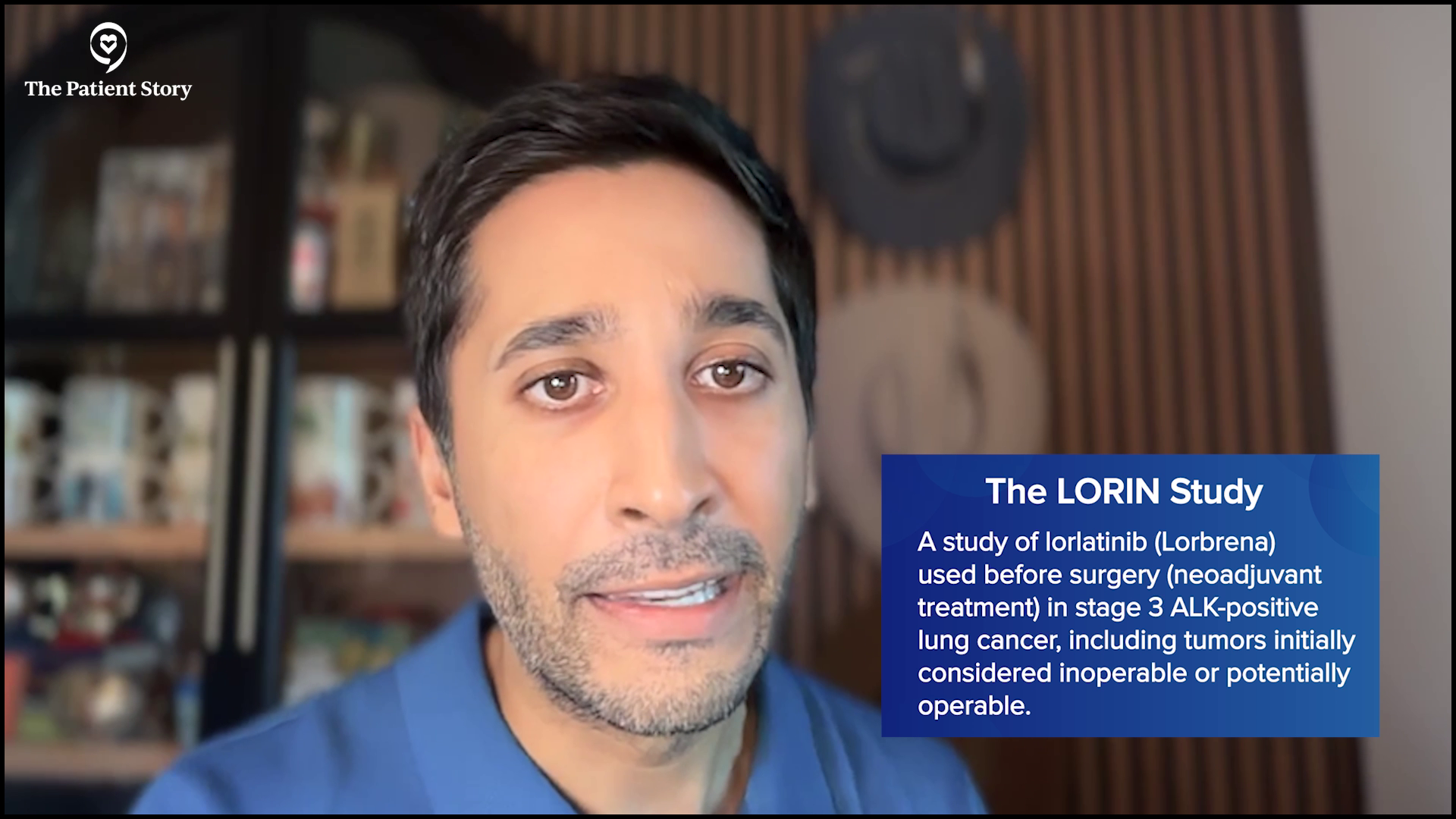
Dr. Singhi: I can start with the LORIN study. This was one that was exciting and it wasn’t even for patients with metastatic disease. It asked a very different question: if we can use lorlatinib, an oral ALK targeted therapy, before surgery. Jill, as you said, some of the patients who had stage 3 ALK-positive lung cancer in this study were initially told that surgery wasn’t possible for them. Then LORIN asked whether targeted therapy could change that possibility for patients.
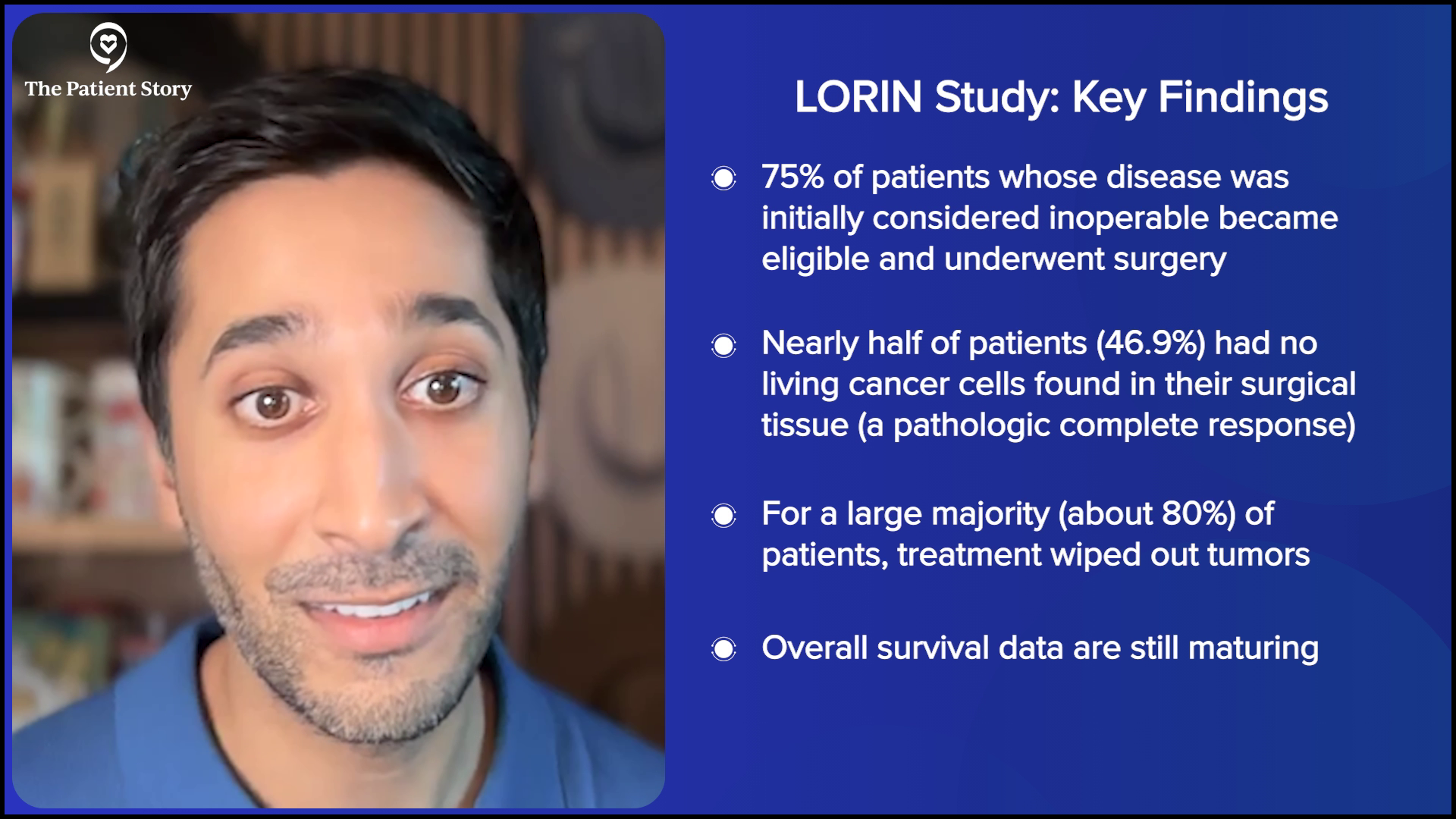
What we saw and what we heard at ASCO was that among those patients who were initially considered to be unresectable, who could not go to surgery, three out of four of them, or 75%, ultimately became eligible for surgery. That’s an incredible transformation. That’s also a number that we don’t get to hear very often, so that was exciting.
We also heard some updates about the pathology, or pathologic complete response. Nearly half had absolutely no living cancer cells remaining in their surgical specimen, which is incredible, and almost 80% of them had major tumor eradication. That’s telling you, from a pathologic outcomes perspective, that this drug can work for a select group of patients before they go to surgery.
Jill: For pathological response, what does that mean post-surgery for a patient? I know there isn’t data, but how do you imagine people who have a complete response versus people who don’t? Do they just have surgery and they’re all done? How do you think that will play out?
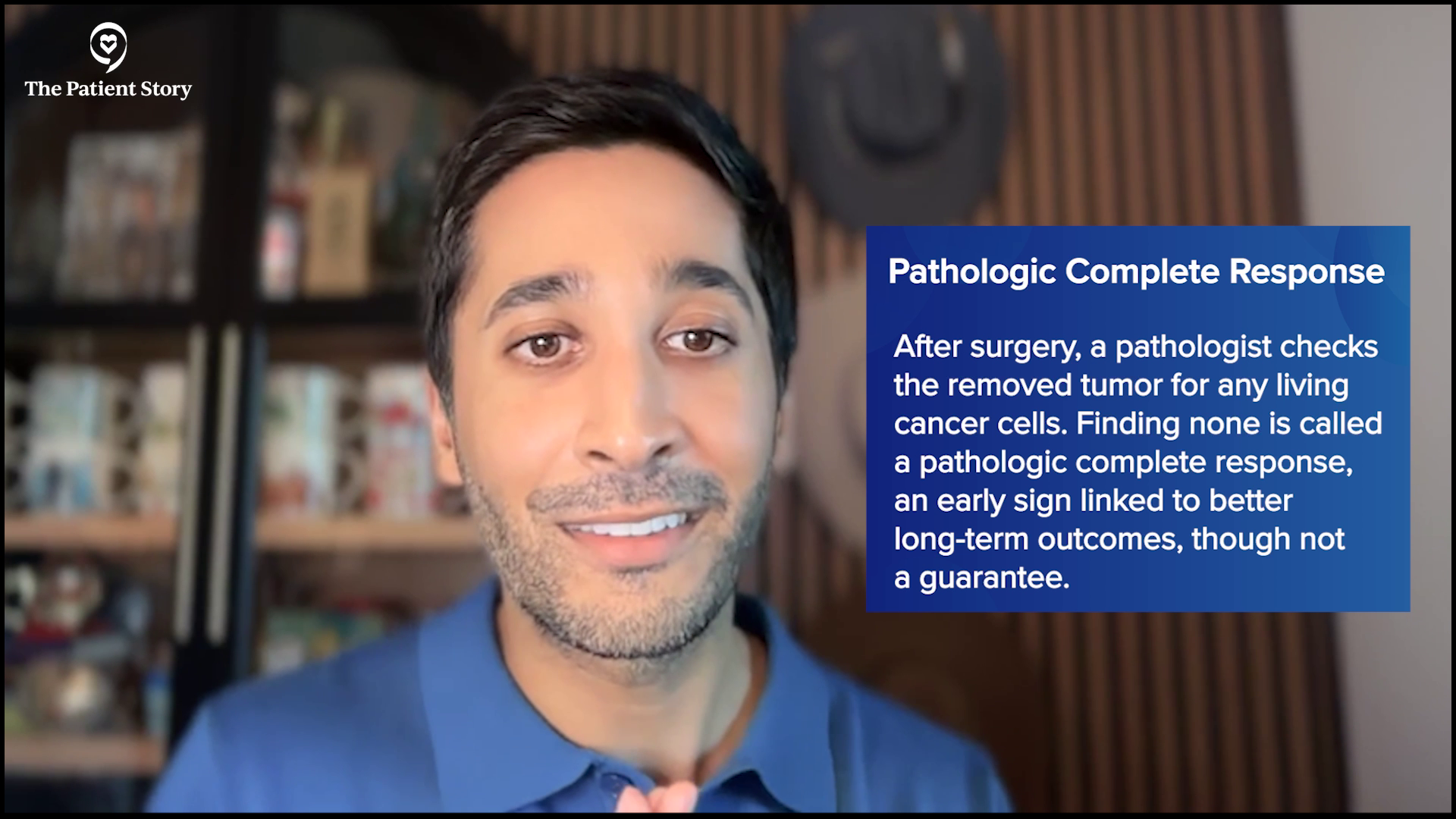
Dr. Singhi: That’s a great question. Pathologic complete response is a surrogate marker for long-term outcomes for patients. It’s an easier way for us to figure out how patients are going to do based on all the treatments that we’re choosing.
A patient gets some type of drug therapy for a certain amount of time and then they go to surgery. At the time of surgery, the tumor is removed, which then goes to your friendly pathologist. They look under the microscope to see how many cancer cells are still alive. The ideal response and the response that we hope for is zero residual viable tumor cells or cells that are alive. That’s what we call pathologic complete response.
Now we have some very early data that seems to suggest for patients with lung cancer that if patients achieve a pathologic complete response, the chance of them having a very long-term outcome — being able to live longer to achieve overall survival, have a reduced risk of the cancer coming back — is exceptionally high. Not a perfect correlation, but a very strong trend that we’re seeing. It’s going to take more time and more patients to better understand that, so more to come on that.
But if patients achieve a pathologic complete response, we have a very good feeling. It doesn’t necessarily mean that they should stop their drug therapy after surgery. Adjuvant therapy or continuing drug therapy after surgery can still be a very important tool to use in our kit to help reduce that risk of recurrence.
Jill: Right. Hopefully, someday soon, we’ll know who needs that therapy and who doesn’t. We don’t want to undertreat and we don’t want to overtreat. That’s exciting.
What happens if current treatments stop working?
Jill: Can you walk us through the ALKOVE-1 study? For people who are on treatment and are doing well, in the back of our minds, we always think about what’s next. You want to know that there’s another safety net waiting there for you. That is what I found exciting about the ALKOVE-1 study.
Dr. Singhi: Yeah, absolutely. I shared all of my excitement about the CROWN data, the 7-year overall survival updates. As exciting as that data is, there’s still one major challenge in ALK-positive lung cancer: Eventually, many of those cancers still learn how to outsmart even our best targeted therapies. You’re exactly right, Jill. Patients and families are asking: What happens then? But so are oncologists. We’re asking: What’s going to be our plan B? C? D? We want to know ahead of time before we get there.
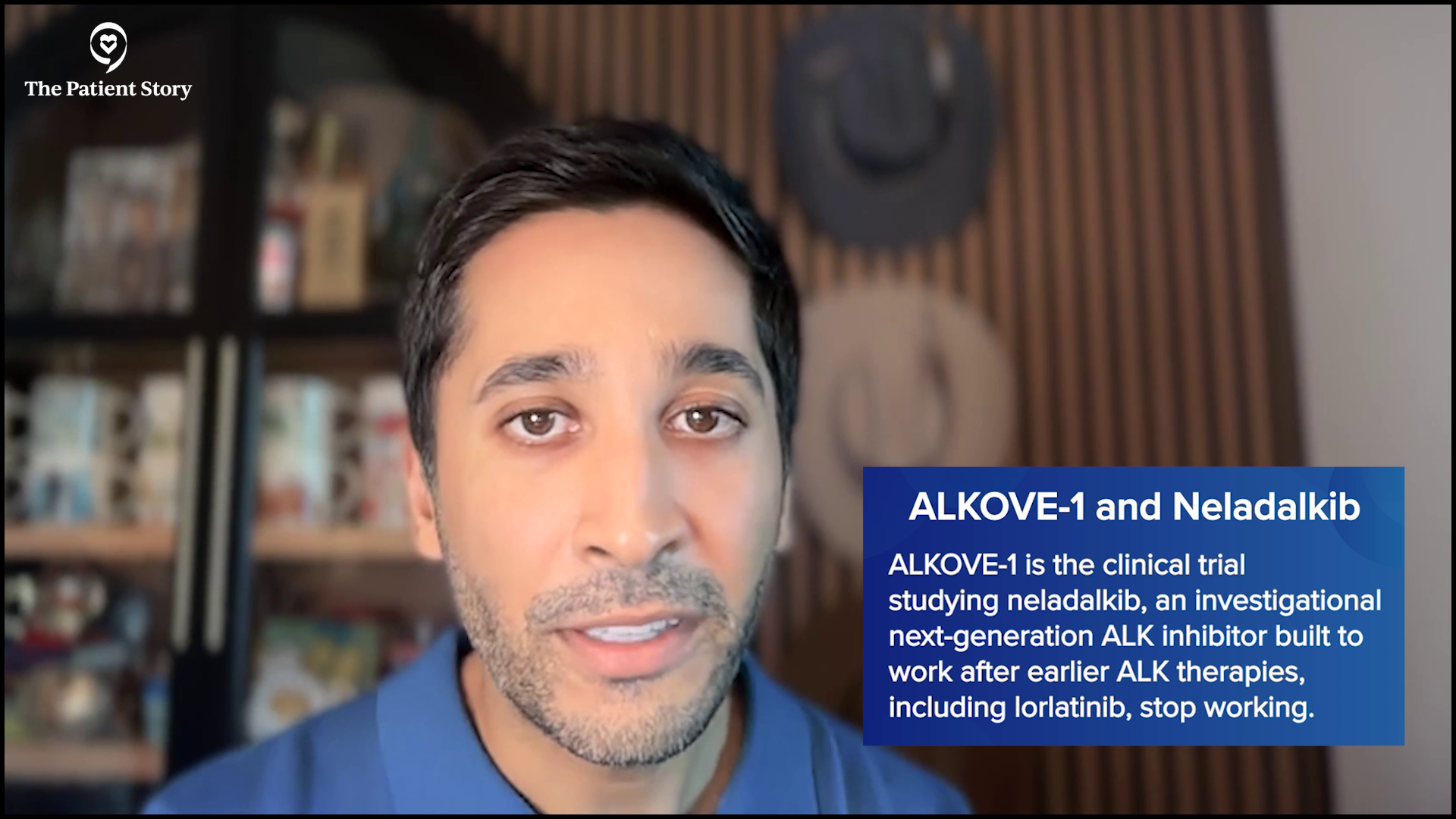
That’s where neladalkib and the ALKOVE-1 data came in at ASCO and provided some reassurance. Neladalkib is a fourth-generation ALK inhibitor. I told you about the different generations of iPhones. We’ve gone from the first-generation iPhone all the way up to… I don’t know where we’re at now. iPhone 15? 17? In the ALK landscape, we’re now going from one to four. Neladalkib is a fourth-generation ALK targeted therapy.
Rather than simply being another ALK drug, it was very specifically engineered to overcome resistance that can develop after exposure to earlier-generation ALK targeted therapies, including lorlatinib, and it helps with that. It also helps with reaching the brain very effectively, extremely well. It can avoid some off-target TRK inhibition that contributes to a lot of those neurological side effects that people can get with earlier-generation drugs. That’s the mechanistic standpoint of why it may be different.
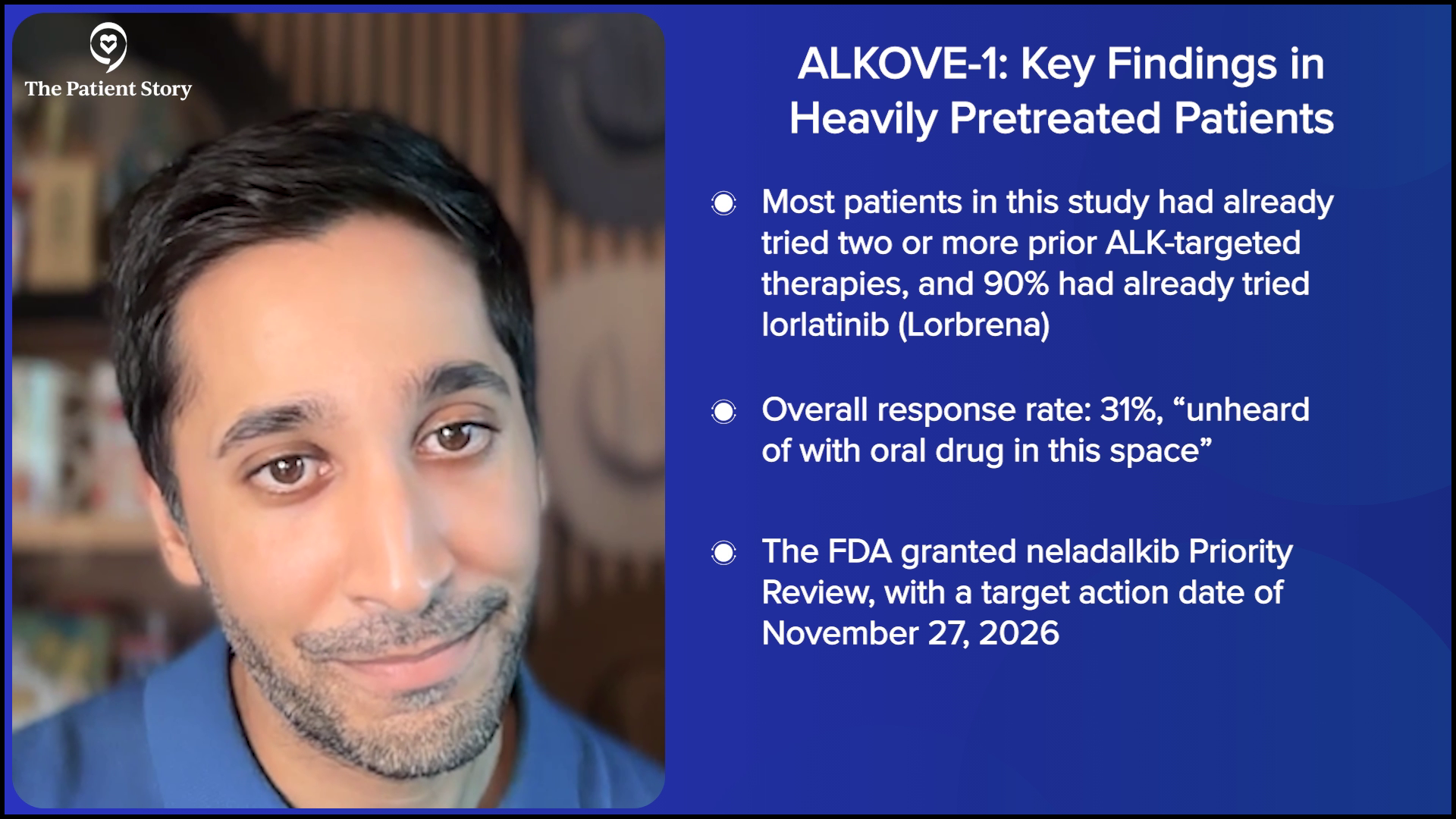
Now, what we heard about weren’t necessarily newly diagnosed patients. What we heard about were patients who were heavily pretreated, so they had received several different drugs before they tried neladalkib. From the data we heard at ASCO, nearly 80% of the patients had already received at least two prior ALK generation drugs and 90% of them had already received lorlatinib.
Despite these patients being some of the hardest patients to treat and see a good response, what we saw was that nearly one out of every three patients who were on this study were able to achieve a meaningful tumor shrinkage. That’s 31% of patients. That’s also unheard of with an oral drug in this space.
Jill: Yeah, especially heavily pretreated. That’s incredible.

Clinical trials: An active option, not a last resort
Jill: I want to take a minute and talk about clinical trials because these drugs are helping people live seven years or are giving people more options now, and we only have these treatments because of clinical trials. Many people still worry that they’ll be treated like a guinea pig or lose access to treatments that are already available. I understand those concerns. Many people think it’s a last resort. I understand that as well because it used to be.
But again, everything we have exists because patients participated in clinical research. It’s important to note that in recent years, they’re not just a last option. Depending on where someone is in their treatment experience, they may be the best option. It’s always important to ask your care team about whether there’s a trial that’s appropriate for you, whether you’re newly diagnosed or you’re on a second- or third-line treatment option. Clinical trials sometimes are truly becoming the best treatment for patients, right?

Dr. Singhi: Thanks for emphasizing that, Jill. It’s so important. I tell patients and their families in my clinic that a clinical trial may be an opportunity to receive tomorrow’s drug today. We’re not just talking about tomorrow; this could be years in advance of receiving an approval. We’re quoting numbers here, even for patients who are previously treated, that are unheard of. It’s a real opportunity to move the field forward, but also to hopefully help your particular case. Please, at any point in your cancer care journey, ask your oncology team about clinical trials.
Living well: Finding community and quality of life on long-term targeted therapy
Stephanie: Thank you so much, Dr. Singhi, for the reminder that patients should take up space and time in that room, and that the partnership between patients and providers can get stronger. Now hearing from Summer one more time to get the patient perspective is so important. She’s already talked with us about her diagnosis, the data, and what hope looks like day to day. But Summer, there’s one more piece of your story that ties all of it together, which is how you found ALK Positive Inc. and why you’ve stayed so involved ever since. Share with us more about finding your community and any advice you want patients and care partners to walk away with today.
Summer: My dad found the ALK Positive website, which then led us to an ALK Positive Facebook community; that was definitely a culture shock for him. I had never been in a support group with Jackson. I had this connotation in my head: I didn’t want to sit around with parents feeling sorry for themselves, which is not what it is.
[The ALK Positive support group] was the biggest gift and such a lifeline.
Summer Farmen, ALK+ Lung Cancer Patient Advocate
I probably wasted a lot of time. I was always the healer, working with other parents, so I hadn’t been in a support group. My dad pushed the ALK Positive support group on me, which was the biggest gift and such a lifeline. To hear the patient voice and to see them was a little traumatic, but we immediately dove in and started learning. There was validation in there. Immediately, you formed bonds with people and started to get an idea of next steps, so that was huge.
I was diagnosed in 2020. Meanwhile, the pandemic was raging and Zoom’s popularity was skyrocketing. Unbeknownst to me, behind the scenes, my now dear friend Mark Rosenzweig, a patient who just celebrated 10 years, asked, “Why don’t we use Zoom to connect people?” He reached out to then ALK Positive president, Gina Hollenbeck, and together, they worked to start ALKtALKs, a patient education, information, and empowerment program.
Mark also started reaching out. I believe he started with his local cancer center. He saw what they were doing in terms of mental health classes and decided to then bring that to Zoom. He worked with Wayne State, I believe, and found an art therapist that could do this as an internship. I have a crazy supportive family, but nobody gets it quite like somebody actually living it.
Mark, Gina, and I then all became close friends and we brought in our other friend, Dana Credo, who ended up being diagnosed along the way. With one of our friends, Linda Webb, we start collaborating and working together to develop this healing arts program. As this grew, more patients started to come forward. “How about a book club?” “I don’t have a care partner and I feel like there needs to be a space for single ALKies.” “What about young ALKies?” At one point, we even had a cooking group. All these subgroups started popping up of patients volunteering their time and us opening the Zoom channels, giving patients and care partners spaces to connect.
Jill: Let’s go back again to the shared decision-making conversation. We’ve talked about all this exciting data and what it means for people diagnosed with ALK lung cancer, but it’s only helpful if people are comfortable talking to their oncologist about these treatments and to understand enough so that they can have those relational conversations, express what’s important and meaningful, and make informed decisions together — informed, shared decision-making.
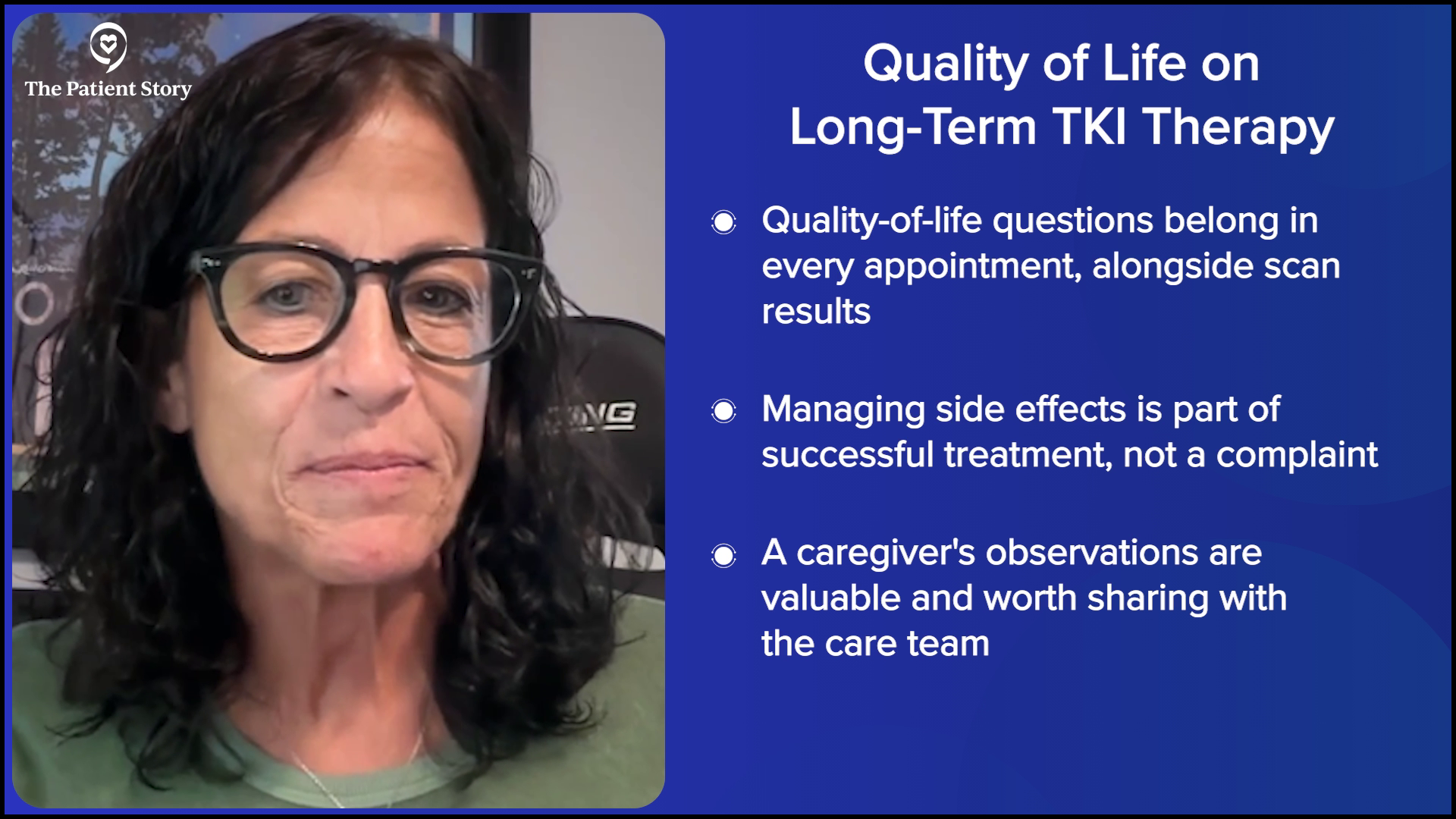
I want to emphasize that it includes discussions about quality of life. We spend a lot of time talking about scans and what they mean, blood work, and progression response rates, and that’s all important. But the other side of the story is what that means for patients and their families. Many of these patients will be on targeted therapies way longer. We could be talking decades if we’re at seven years already with lorlatinib. Living with these side effects is different from surviving on the treatment. I always point out that even low-grade side effects can impact quality of life, work, and time with family.
Quality of life isn’t separate from survival. It’s part of it. They’re together.
Jill Feldman, Lung Cancer Patient and Advocate
I want to emphasize that quality of life isn’t separate from survival. It’s part of it. They’re together. You experience the side effects at the same time you’re experiencing survival. Part of good cancer care is recognizing and addressing that with patients.
But many patients still feel guilty bringing up their side effects because they think, “I’m just grateful that I’m alive,” right? They think it has to be a trade-off. I always say that it’s not complaining. It’s part of being able to stay on treatment successfully and an important conversation. For caregivers, their experience matters too. What they see sometimes is more accurate than what we report. What are your thoughts on that?
Dr. Singhi: Yes, yes, yes. I’m always in 100% agreement with your viewpoints, Jill, but especially with this. It’s important. The highest dose isn’t always the right dose. That’s a strong message to take away. I love follow-up data that gives reassurance to patients and providers that it’s okay to make a treatment reduction if patients are going to feel better. If it doesn’t compromise efficacy, why wouldn’t we do it?
Please bother your oncology team if you’re experiencing side effects, because we want you to live well and very meaningfully for a long time, hopefully on the same drug. If you’re having grade 1 or grade 2 side effects every day, those add up. We want to know and we want to see how we can help because many times we can. Please tell us.
Reach out and find your community of people who are living the same life because in that common diagnosis, there is a shared bond.
Summer Farmen, ALK+ Lung Cancer Patient Advocate
Key takeaways
Summer: You’re not in this alone. That would be my number one piece of advice. You could be surrounded by people and still feel alone. People aren’t always sure how to best support or respond to a cancer diagnosis, so even those who love you the most may not necessarily be supporting you in the way that you need. Reach out and find your community of people who are living the same life because in that common diagnosis, there is a shared bond. They will understand your sick and twisted jokes. They will understand your greatest fears and your little successes that are actually huge successes that mean different things to different people.
It can be hard to put yourself out there. I went 19 years without any type of support group for dealing with Jackson’s cerebral palsy diagnosis, but I wonder what different little things I could have gained along the way. Find your people.
The best treatment decision is an informed decision.
Jill Feldman, Lung Cancer Patient and Advocate
Jill: Absolutely. Thank you. If there’s one takeaway from this discussion for me, it’s that we’ve made incredible progress in ALK-positive lung cancer. We know that the treatments are dramatically different than what existed even a decade ago and we’re continuing to move forward at a pretty fast pace. But it’s important to remember that every treatment is personal and it’s important to learn about your options. Ask questions. Talk openly with your care team to learn about risks versus benefits. The best treatment decision is an informed decision that’s right in the context of your life.
One other important takeaway is the importance of comprehensive biomarker testing. You can’t benefit from these therapies if you don’t know you’re eligible for them. What takeaway would you give?
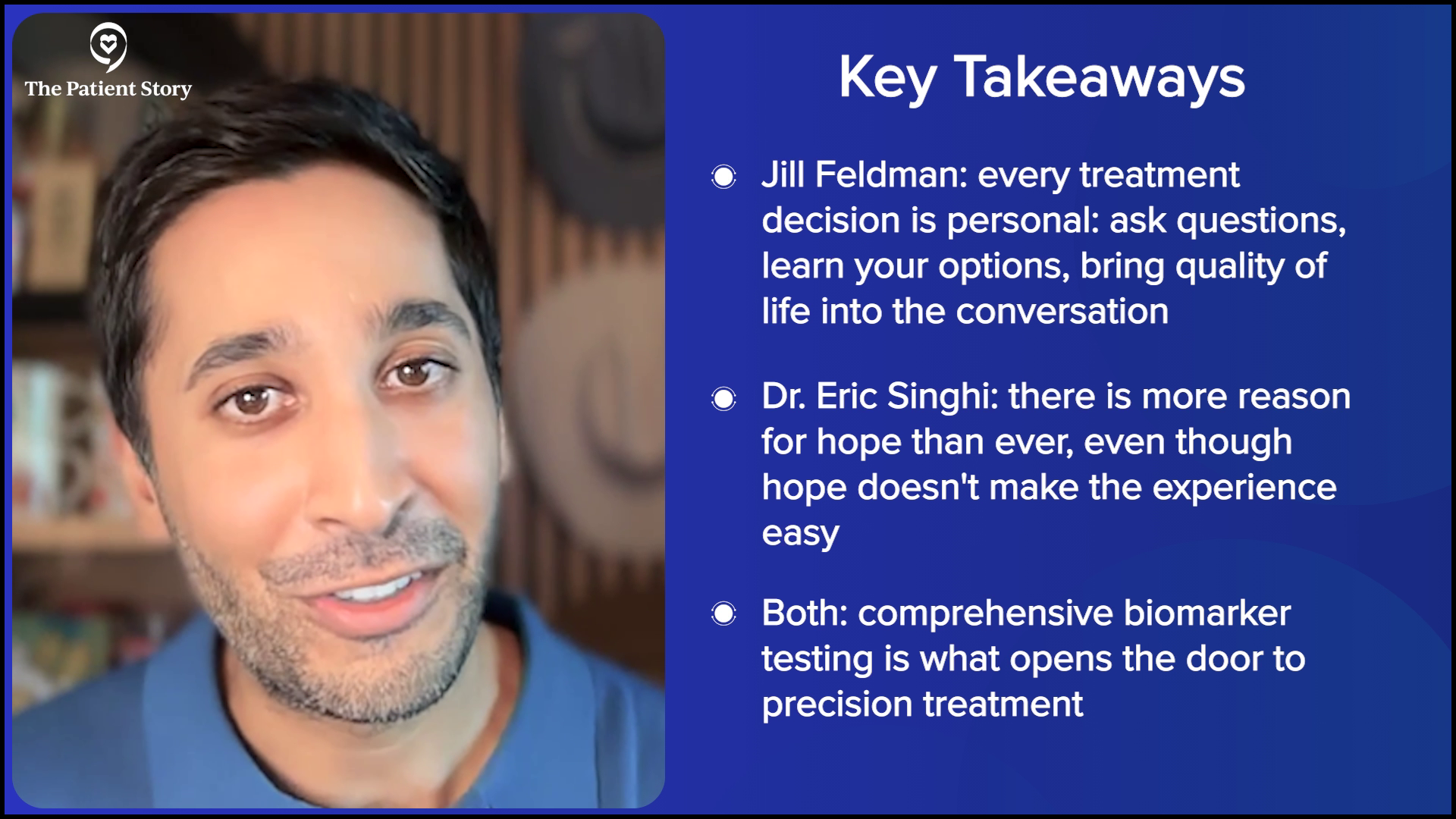
Dr. Singhi: I love your takeaway: You can’t deliver precision medicine if you don’t know the biomarker, so I love that, and I 100% echo that sentiment.
When I meet someone newly diagnosed with ALK-positive lung cancer in my clinic today, it’s a very different conversation than what it would have been five or 10 years ago. Today, I get to very excitingly talk about years of disease control, remarkable protection of the brain, therapies that we are researching actively, designed to overcome things like resistance, and even some exciting studies like LORIN that may expand this treatment into earlier stages of disease.
There’s so much excitement and so much hope. The hope and the excitement, though, don’t mean that the journey is going to be easy. There’s just even more reason for hope than ever before and that’s what I want to stress to patients and their families.
Jill: Hope. I agree. I always show my tattoo. You can’t see it well, but I have a permanent reminder.
Conclusion
Jill: Thank you so much, Eric, for sharing your expertise and helping us understand these advancements in research. Thank you to everyone for joining us. Hopefully this conversation leaves you feeling more informed, more confident, and better prepared for the next conversation you have with your team.
If you’d like to learn more about ALK-positive lung cancer, connect with others, or stay up to date on the research, you can do all this and find updates if you visit the ALK Positive patient advocacy group. I will hand it back to you, Stephanie.
Stephanie: Thank you so much to you, Jill, for pulling this through with the patient voice as a thread, to Dr. Singhi for helping us make sense of this year’s ASCO news, and, of course, to Summer for sharing her own story with us and highlighting some incredible resources out there.
If you would like to learn more and connect with others, visit the ALK Positive Inc. patient advocacy group at alkpositive.org.
Don’t forget: We want to hear from you. Share with us what you hope we can dive into more next time.
I’m so glad that you could join us. Hope to see you again at our next conversation. We have many stories on our website and our YouTube channel. For now, I’m Stephanie Chuang. Take good care.
Program Partner
Thank you to ALK Positive for their partnership. Learn more about ALK Positive’s patient support, educational resources, peer mentoring, and clinical trial programs. ALK Positive is a global patient-driven nonprofit dedicated exclusively to improving the lives and outcomes of people living with ALK-positive cancer through research, education, advocacy, and peer support.
Program Sponsor
Thank you to our sponsor for their support of our independent patient education program. The Patient Story retains full editorial control over all content.
This interview has been edited for clarity and length. The views and opinions expressed in this interview do not necessarily reflect those of The Patient Story. This content does not replace professional medical advice.
Hear from people living with ALK-positive lung cancer
Real experiences with diagnosis, treatment choices, side effects, and life beyond ALK+ lung cancer — in their own words.