
The Nickel-Sized “Bruise” That Changed My Life: Sophie’s Stage 2 Ewing Sarcoma Story
Sophie’s story begins with a strange, round robin’s-egg–blue spot on her upper arm that didn’t hurt, fade, or otherwise behave like a normal bruise. Pushing for answers led to a diagnosis of soft-tissue Ewing sarcoma, a rare kind of cancer, at age 31. Initially, a doctor thought it was nothing serious. But Sophie trusted her gut and insisted on further checks. Her persistence led to an ultrasound, a surgery, and eventually the devastating phone call: it was cancer. She had never even heard of Ewing sarcoma before that day.
Interviewed by: Nikki Murphy
Edited by: Chris Sanchez
Sophie’s experience emphasizes the importance of self-advocacy, particularly for adolescents and young adults. She quickly learned that waiting months to be rechecked wasn’t an option. Pushing for answers, she navigated multiple appointments, imaging scans, and pathology reviews until she received a clear diagnosis. Along the way, she also discovered the emotional toll of rare cancers like Ewing sarcoma, namely fear, uncertainty, isolation, and how it can feel when life halts while friends and peers continue moving forward with weddings, new jobs, and other milestones.
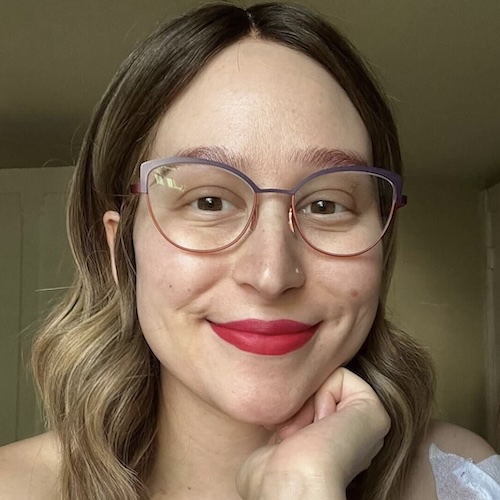
Sophie’s treatment involved 14 cycles of chemotherapy over 10 months, split between inpatient and outpatient sessions, plus a second surgery to secure clean margins after the first removal proved insufficient. Uncomfortable side effects like fatigue, nausea, food aversions, and hair loss became part of her new reality. But she found ways to manage the cycles and focus on what she could control. She realized that mental health was as important as physical health, and leaned on family and close friends who stayed present through the hardest days.
She now has no evidence of disease (NED), and continues regular scans and bloodwork to monitor her health. Sophie hopes her story encourages others to listen to their bodies, speak up if something doesn’t feel right, and seek specialists for rare cancers like Ewing sarcoma. She also wants to shine a light on the psychological impact of cancer in young adults: how it reshapes expectations, identity, and hope, and stresses that research into rare cancers must continue to grow.
Watch Sophie’s video and check out the transcript of her interview. You’ll find out more about:
- The little round blue “bruise” that turned out to be something far more serious
- How one young woman pushed for answers when doctors said to wait six months
- How Sophie’s story evolved from a casual doctor’s visit to a life-changing cancer diagnosis in just weeks
- The emotional toll of facing mortality at 31 while friends moved forward with life milestones
- Hard-won lessons on self-advocacy, resilience, and finding strength in the face of Ewing sarcoma
- Name: Sophie F.
- Diagnosis:
- Ewing Sarcoma
- Age at Diagnosis:
- 31
- Staging:
- Stage 2
- Symptom:
- Appearance of a nickel-sized, blue, and solid but soft and spongy mark on upper left arm
- Treatments:
- Surgeries: cyst excision surgery and wide excision surgery
- Chemotherapy
This interview has been edited for clarity and length. This is not medical advice. Please consult with your healthcare provider to make informed treatment decisions.
The views and opinions expressed in this interview do not necessarily reflect those of The Patient Story.
- My name is Sophie
- The first symptom I noticed
- Finally seeing my primary care doctor
- The day of my surgery
- How I reacted to my diagnosis
- My treatment plan
- My wide excision surgery and its physical impact
- The side effects I experienced
- Finishing chemotherapy
- Life as “No Evidence Of Disease”
- The hardest part of my diagnosis
- The part of my old self I will never get back
- What I want others to take away from my story
- Why advocacy for young adults with cancer matters to me
My name is Sophie
I am from Syracuse, New York, and I was diagnosed with Ewing sarcoma soft tissue in 2022.
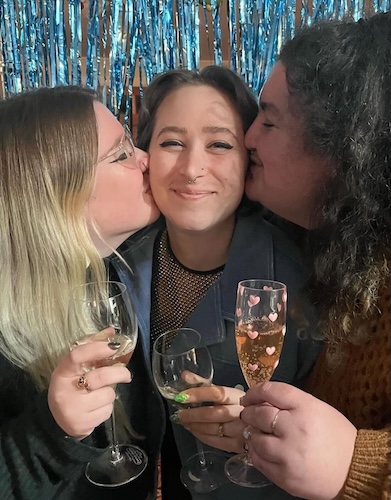
I was in the prime of my life. People around me were getting engaged, getting married, having kids, buying houses. I felt stuck in time while everybody else was advancing, and I was standing still, finding out whether or not I was going to die.
Cancer was unexpected, very challenging. It completely changed who I am as a person, but also brought some good things into my life.
The first symptom I noticed
I actually only ever had one symptom before I was diagnosed. It was back in fall 2021. I was looking in the mirror one day and caught a glimpse of the side of my left upper arm, and it looked like there was a bruise there.
It was a weird-looking bruise. We all know what bruises look like, and this was bruise-like but just slightly different. It was not a faded look. It did not have that kind of blue-yellow. It was just pure blue, almost like robin’s egg blue. It was pretty much perfectly symmetrical, nickel-sized, perfectly round.
It was not sore to the touch or anything. It did not hurt at all, and it did not come out of my skin; it was not raised. When I touched it, I could move it back and forth under the skin. At first, I thought it was just a weird bruise, and there was blood pooled under there, like happens with bruises sometimes, but it was moving as a solid.
The blue would move as one, and then I would push it back, and it would move the other direction. That was the only symptom I had. I felt totally fine otherwise. Within a week or two of noticing that, I went to the doctor because a bruise typically goes away pretty quickly and usually hurts or is from something.
I knock into stuff all the time, but this was significant enough that I should have known what I did. I went to the doctor, and the doctor I saw, who was not my PCP but was in the practice, barely examined me. I do not even know if she touched it. She looked at it and basically said, “That looks fine. You are young and healthy.” I was 30 years old, and I had no other symptoms. She said it was probably a hematoma, a bruise, or maybe a lipoma, a fatty deposit, but she was not really worried about it. She said if I was still experiencing symptoms in six months, I could come back.
I went home, and it did not sit right with me. The fact that she barely examined it and what she said about it did not make sense with what I was seeing and feeling. Within maybe two weeks after that, I called the doctor’s office back and said I needed to get in sooner. I said I was not comfortable with somebody not taking a closer look at this. I was told that there were no spots available for three months, which is not accurate in my opinion. There have to be sick visits.
Finally seeing my primary care doctor
I have a friend who went to the same doctor’s office who got a sick visit when he had a sore throat, but apparently, there being something wrong with my arm was not enough for a sick visit. They basically blew me off and said the doctor did not want to see me back for six months anyway.
So I waited three months. In that period, I thought about it a lot. I thought about trying to be seen somewhere else, but I had just moved back home to Syracuse after being away for over a decade, and it was hard enough to find a PCP, much less to try to find another PCP. The spot on my arm did not change after the first time I saw it. It remained the same, looked the same, and I felt fine otherwise.
The people in my life were not worried about it. I am kind of a hypochondriac; I always have been. They said, “You need to trust the doctor on this. If she is not worried, you do not need to be.” Finally, I went back three months later. I saw my actual PCP. She was also not super concerned, but she definitely took it seriously. She thought it was weird that it had not gone away and suggested an ultrasound to get more information. It took a couple of weeks to get the ultrasound.
The ultrasound results showed an abnormal cyst. It looked like a cyst, a fluid-filled sac, but it had blood flow, which cysts usually do not. I asked what that meant, and she said it could mean a variety of things. She said she was still not concerned, but we had a couple of options: watch it for a few months, do an MRI to get more information, or have surgery to get it taken out.
At that point, it had been about four months since I first noticed it, and I just wanted surgery. I did not know anything about what steps you are supposed to take if something is suspicious because I had not dealt with that before, and she never said, “I think this might be cancer.” I said, “Let’s just schedule surgery so we can get it out. I do not want to deal with this anymore. I just want it gone. It is weird.”
It took another two months to get the surgery scheduled. This was fall–winter 2021 into early 2022. COVID was still in full force. There was a new wave and a new strain, so it was really rough trying to get medical care.
The day of my surgery
In February 2022, I finally had it removed by a regular surgeon, just a run-of-the-mill surgeon. She was great. She also was not worried about it. After the surgery, she called and said it went awesome. It was mostly just blood in the cyst, and it did not look weird. She was not concerned but was sending it to pathology because that is what you do. I felt it was no big deal. It was a very small incision, and I felt fine.
A week later, she called me and said, “I am really sorry. I was wrong. It actually is cancer.” They did not know what type of cancer it was. They had sent it to pathology in Syracuse, and they were not coming up with a definite diagnosis. It could have been anything from blood cancer to skin cancer to what they wrote down as their best guess, which was Ewing sarcoma, which I had never heard of before.
She told me not to look that up because they really did not know what it was yet, and she did not want me to freak out. They were sending it to Memorial Sloan Kettering in New York City so they could run their pathology. Knowing it was cancer, I was set up with an oncologist and a surgeon. It was three weeks before I got my official diagnosis, which ended up being their best guess: Ewing sarcoma. That was March 1st, 2022, when I finally got the confirmed diagnosis.
How I reacted to my diagnosis
I was shocked. I was really surprised and terrified. That phone call where she said, “You have cancer,” was the most scared I have been throughout the entire experience. Not only was I hearing “you have cancer” when I had just turned 31, but they did not even know what it was.
I was distraught. I was with my friend when I got the phone call. It was a regular weekday afternoon. I immediately called my parents; they came over. My friend left. It traumatized her, understandably. I cried for a good while, but more than anything, I was scared. I was imagining all the things it could be and what that could mean, with no information yet on how aggressive it was, whether it was localized, or even what category I was dealing with.
I mentioned earlier that I have been a hypochondriac my whole life, though “health anxiety” is probably a better phrase. It had always been unfounded. I would get something checked out, and it would be nothing. I would always hear “you are young and healthy, you are fine.” I had been concerned that it was cancer or something more serious, but in the same way I had always worried, not more than usual.
When I found out that it was cancer, I felt a little validated or vindicated, like, “I told you so.” I had said this was weird. I had said it did not sit right with me that I was having to wait. Finally, after pushing and not getting answers and after basically a lifetime of health anxiety, my anxiety was right.
That was something I went on to struggle with for the next three years: what do you do when you are anxious about something for so long, and then one time you are right? What does that mean for every other thing you are going to be anxious about in the future? How do you not believe it is something life-threatening every time?
My treatment plan
I was referred from the general surgeon to an orthopedic surgeon in Syracuse, who is the person for cancer of the limbs. Even without an official diagnosis, he looked at the clinical signs, symptoms, and the pathology report and was pretty convinced it was going to be Ewing’s.
He said, “We do not know for sure what this is, but here is what you probably have in front of you.” That was very helpful. He was the first person who told me I was probably going to need surgery and chemo, if not also radiation. Once I got the official diagnosis a few weeks later, I met with my medical oncologist, whom he referred me to, and I had scans to stage the cancer.
The treatment plan was the same as for pretty much anybody else with Ewing sarcoma. It is very specific and targeted. It was five chemotherapy drugs over the course of about eight months to a year, depending on how long it takes and how your body reacts. For me, it was 14 cycles total: seven inpatient and seven outpatient.
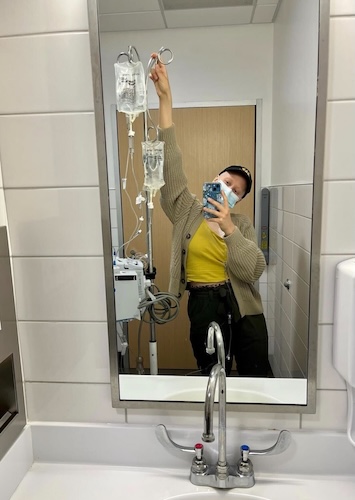
The outpatient chemo was what you imagine when you think of chemo. You go to an infusion room with a lot of other people and get an IV with chemo. The other seven cycles were inpatient, where I had to live at the hospital for a week and get drugs every day for five days in a row. It was either three drugs every day for five days or two drugs for five days.
I would have two days of outpatient chemo, then two weeks later, five days of inpatient chemo, and then two weeks later, another round. It had to be spread out more as I went on because my body took longer to recover. It ended up taking about ten months.
With Ewing’s, if the tumor is operable, which mine was because it was in the soft tissue, you typically have surgery about halfway through. After the first six cycles of chemo, you have surgery and then eight more cycles. When I had the initial cyst removal, which turned out to be the tumor, they could tell they did not get clean margins because they were not operating as if it were cancer. They were operating as if it were a cyst, so they did not take much of the area around it.
I had to get a second wide excision surgery in the middle of chemo to take an extra inch in all directions around where the original tumor was to get clean margins. I did not need radiation. Some people do, especially if they cannot operate in the area. They got clean margins with the second surgery, so I did not have to do radiation.
My wide excision surgery and its physical impact
The wide excision surgery was actually an easier part of my treatment. Because it was in the soft tissue layer, not in the muscle or bone, it was essentially digging around in my soft tissue and then sewing it back up. There was a chance I was going to need a skin graft, but my surgeon was awesome and was able to do it, so I did not need that.
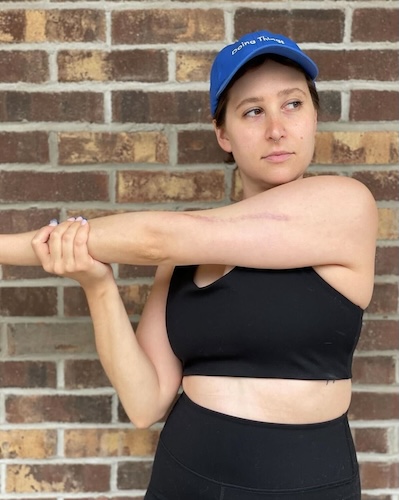
I have a pretty gnarly scar, and you can tell there is a chunk out of my arm. It should be one shape, and it is not, but I have full function of the arm. I might have a little less than full muscle capacity, but it was about an hour-and-a-half-long same-day surgery with a fairly easy recovery. The chemo was the truly challenging part.
The side effects I experienced
I had a whole host of side effects, but the main one was extreme fatigue. I was insatiably exhausted after chemo. After outpatient chemo, usually two to three days later, I would crash and be crashed for five or six days.
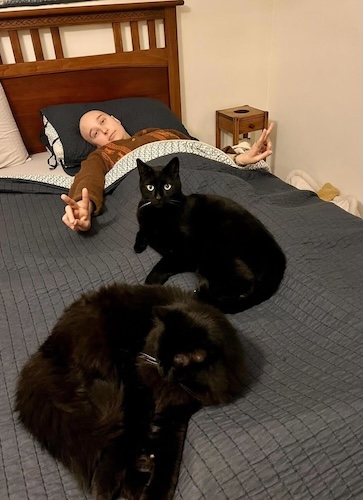
For inpatient chemo, the first or second day might not be so bad, but by the third day, I was exhausted, and that lasted up to a week after I got home. I would sleep 12 to 14 hours a day and still be exhausted. I would wake up, force some food down, and go back to sleep.
Other common side effects were nausea and lack of appetite. I only vomited once during the entire treatment, but I had really severe nausea and zero appetite. I did not want to eat. I had a food aversion; I knew I had to eat, but seeing food grossed me out.
At the beginning of treatment, I had to go to the ER a couple of times when my immune system was really down, and my blood counts were low. After my second round of chemo, I noticed a little pimple on my leg that, within an hour, became really big and looked angry and infected. That meant an ER visit. It turned out to be a skin infection that normally probably would not have done anything, but with almost no immune system, it was dangerous. I had IV antibiotics, was there for 24 hours, and they monitored me closely.
A few cycles later, I was back in the ER because I spiked a fever, which is really dangerous when your blood count is low, even if you feel fine. I had IV antibiotics again and a blood transfusion. I had another blood transfusion one cycle after that, or a few days later in the same cycle.
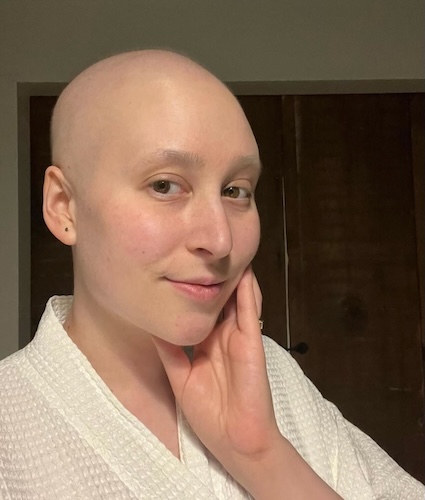
I got tired easily. A walk around the block would leave me exhausted. It was a physical and mental-emotional fatigue that was very heavy. It felt almost impossible to lift it. I lost all my hair on my entire body. That is a side effect I usually do not think about because it just happened and stayed that way for ten months, but it was still not easy.
I also had occasional mouth sores and sometimes gland pain. Once I spaced out my treatments after the third or fourth round, many of those side effects improved. I did not go to the ER again. I learned how to manage the cycles of fatigue and nausea, and it became a little easier.
Finishing chemotherapy
I finished chemo the day before my birthday. I had set goals for when I wanted to finish. I wanted to go to my best friend’s wedding, but after spacing out treatments, I was still in treatment then and could not go. I wanted to finish before the holidays so I would be home; that did not happen. My final goal was to be done before my 32nd birthday, and I did that.
I wish I could say I felt absolutely amazing and it was awesome, but at the time, it was not as joyful or as much of a relief as I expected because I was so tired. After 14 rounds of chemo and two surgeries, I kind of collapsed. I was really proud and really grateful to be done. Ringing the bell was meaningful; I got to do it twice, once for inpatient and once for outpatient. I felt a big sense of relief.
It was not rainbows and kittens. The transition from chemo back to regular life was tough. I had been in a routine for almost a year. It felt like a loss to be done and scary to step outside a routine that included knowing the next step and feeling like I was actively fighting cancer. Suddenly, I was done and just sitting there.
I went from seeing my oncologist and surgeon often to being told, “See you in three months,” which was surprisingly difficult. There were mixed emotions. I was grateful to be done, grateful to be alive, and grateful to be told my scans were clear. I do not take that for granted; it was huge, and I am very fortunate. But it was not as straightforward as I expected.
Finishing chemo felt less like a victory lap and more like collapsing at the finish line and realizing you have to figure out how to live again.
Life as “No Evidence Of Disease”
For Ewing’s, and maybe all sarcomas, they do not use “in remission” or “cancer-free.” They use NED: no evidence of disease, or sometimes NEAD: no evidence of active disease. I was considered NED after my second surgery, about six months before I finished treatment, because the evidence of disease was the positive margins after the first cyst removal surgery. Once they got clean margins, I was technically NED.
My NED anniversary is in July every year, but I still had to do the rest of the chemo because that is the protocol for Ewing’s. For the first two years, every three months, I had scans of my arm, where the cancer was, and my chest, because that is the most likely place Ewing’s would metastasize. It could come back in the original spot or metastasize to the lungs.
I also had blood work to check whether my body was bouncing back as expected or if anything new and weird needed investigation. Starting last July, which was two years ago, my schedule changed to every four months for a year. This upcoming July, when I am three years NED, it will switch to every six months for years four and five. After five years of NED, it becomes every year forever.
I just had scans two weeks ago and got my official results yesterday that they are all clear. I am definitely in a good mood this week.
My NED anniversary is in July, and even though I’m ‘clear,’ I still live scan to scan, year after year, for the rest of my life.
The hardest part of my diagnosis
Many things were hard and continue to be hard. I do not want to downplay how hard chemotherapy was. It was a living hell a lot of the time. But even harder was the psychological and emotional toll that having cancer took and continues to take on me.
Any time you are told you have cancer, it is awful and life-changing in a way you do not want. Being told that at a relatively young age was even harder. I was in the prime of my life. People around me were getting engaged, married, having kids, and buying houses. I felt stuck in time while everybody else was advancing. I was standing still, finding out whether or not I was going to die, fighting for my life.
It really messed with my perception of my life, what I thought it was going to be, and what I expected for myself. I assumed I would be healthy until I was old. My mom is a breast cancer survivor of ten years this month, and she was 60 when she was diagnosed. I knew bad things could happen before people are elderly, but she was 60. I was 30. I never saw it coming.
The hardest part was facing my own mortality at a young age when other people in my peer group were not even thinking about it. For them, health and long life were a given. That is how it had been for me until it was suddenly taken away.
The part of my old self I will never get back
What I miss most about myself is the innocence I had about my expectations for my life, my hopes and dreams, and how I wanted my life to look. It is different now.
People, including me, often assume you go through cancer and then go back to normal. That is not the case for me, and for many adolescent and young adult cancer survivors I have talked to. There is no normal to go back to. It is rebuilding and figuring out who you are after this.
I miss the version of myself that had days when I never worried about anything. If I felt good, I just felt good. Now, when I feel good, it is “I feel good for now” or “I feel good, except the cancer could come back.” I am always looking over my shoulder, waiting for something else bad to happen, whether it is recurrence, metastasis, secondary cancer, or long-term side effects. It never goes away completely. It has gotten easier with time, but it is an intrinsic part of who I am now, and I could never have imagined that four years ago, before cancer.
I miss the version of myself who could feel good without an asterisk, without wondering if it was just a calm before the next storm.
What I want others to take away from my story
There are really two main pieces of advice I would want someone in a similar situation to take away from my story. One is logistical, and one is more emotional.
Logistically, advocate for yourself. Do not take no for an answer if you think something is weird or wrong, even if you have health anxiety or are an anxious person. Push anyway because you never know, and it is better to be safe than sorry. It is better to have something looked at and find out it is nothing than to not have it looked at, or to be brushed off, and have it turn out to be serious at a later stage.
Push for answers. Push for yourself. Take care of yourself. Make sure people are listening to you. If you are diagnosed with cancer, get a second opinion, ideally somewhere with a specialist for your case. For me, there was no sarcoma specialist at my local hospital. It is not a sarcoma center. Going for a second opinion at MSK was necessary for peace of mind that I was getting the right treatment.
On the emotional side, it is easy to say things like “cancer is tough, but you are tougher” or similar platitudes. I do not want to say that. What I will say is that you are stronger than you think you are. I was squeamish and scared of blood, needles, and doctors’ offices. One of my first thoughts was, “How am I going to get through this? I am not someone who thrives in this environment. I hate being sick. What if I cannot do this?”
The answer is you just have to, and so you will. You can do many more things than you think you are capable of, simply because that is the situation you find yourself in, and it is what is in front of you. Take it one step at a time, day by day. Look at what you need to do to move from one place to another. Eventually, you will be in it, and hopefully, eventually, you will be done with treatment and living a cancer-free life.
Whether you are NED or still in treatment, lean on your supports. Do that all the time. Find the people in your life who are going to stay and help you. They will help you get through anything.
You are stronger than you think you are; sometimes you only find out because you have no choice but to keep going.
Why advocacy for young adults with cancer matters to me
There is so much more to say about my experience. The biggest thing I am most passionate about is advocacy, not only self-advocacy but also advocating for increased awareness and resources for cancer, especially for adolescent and young adult cancer patients. It is a very overlooked demographic.
The young adult age range, roughly 25 to 39, has one of the highest recent increases in cancer rates. It is a strange space where more cancer cases are showing up, but there are fewer resources and less awareness. That does not align.
I am passionate about telling my story, talking to others who have been through the same thing or are starting their own journeys, and making sure they feel they are not alone. I am also passionate about advocating at a higher level to make sure providers take this seriously so people do not go through what I went through, being brushed off and told multiple times it was nothing serious.
I hear that story all the time from other authors and patients, and it has to change. People are being diagnosed at stage 3 and 4 when they could have been diagnosed at stage 1 and 2 if they had been listened to.
Another piece of advocacy for me is better treatment options and more research. It is not that people do not want to do the work. There is not enough funding. We are not going to have fewer cancers; we are going to have more people getting cancer. Research is key.
I am very lucky that there was research in the 1980s that gave me the treatment I got. It has not changed since the 80s. It would be amazing if it changed so people did not have to go through 14 rounds of chemo. If they had not done that research, I probably would not be alive right now. Many people are not getting the opportunity to be treated effectively and to live after treatment because of a lack of research funding.
I want people to be aware that this is happening. If someone watches or reads this who did not know, maybe they can talk to others and advocate for young adult cancer survivors.
I’m alive today because of research from the 1980s, and the treatment hasn’t changed since then — that should scare all of us into demanding more.
Inspired by Sophie's story?
Share your story, too!
More Ewing Sarcoma Stories
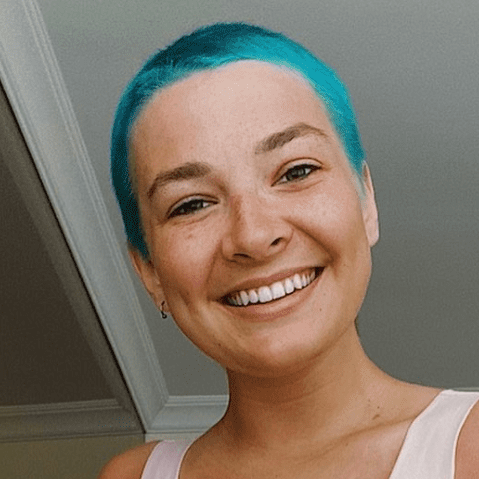
Ariane B., Ewing Sarcoma (Bone)
Symptoms: Aching in arm, lump in forearm
Treatments: Chemotherapy (14 rounds), surgery (of radius), radiation (36 sessions)
...
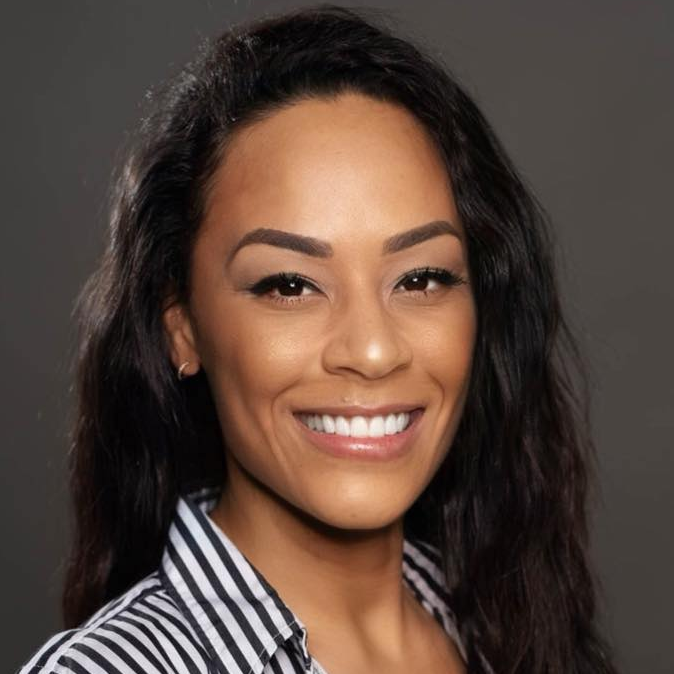
Brandi B., Ewing Sarcoma (Soft Tissue), Stage 1B
Symptoms: Extreme fatigue, lump in pelvic area
Treatments: 17 cycles of chemotherapy in-patient at hospital with (leg-sparing) surgery in between
...
Sophie F., Ewing Sarcoma (Soft Tissue), Stage 2
Symptoms: Appearance of a nickel-sized, blue, and solid but soft and spongy mark on upper left arm
Treatments: Surgeries (cyst excision surgery, wide excision surgery), chemotherapy
...