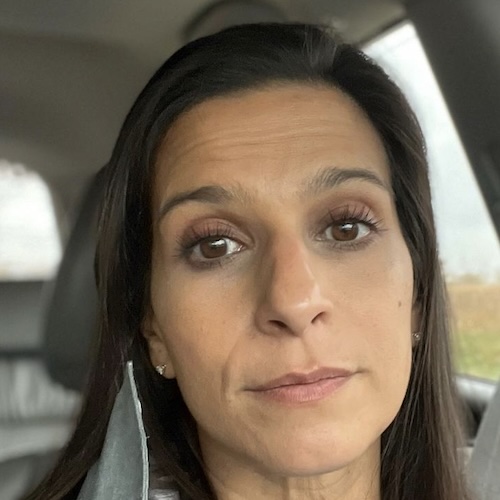
From No Symptoms to Brain Cancer (Grade 2 Astrocytoma): Kelsi’s Story
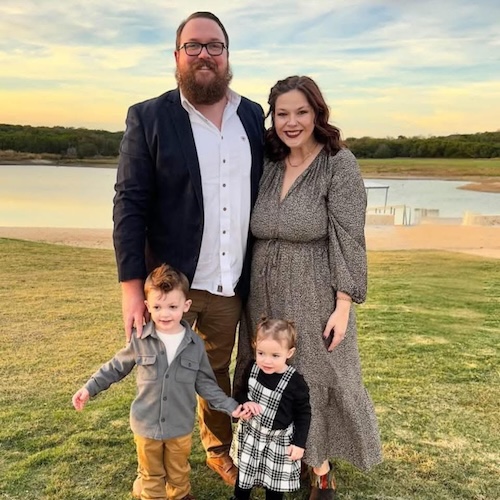
Kelsi’s life changed in ways she never expected when she was diagnosed with a grade 2 astrocytoma, a type of brain cancer, in her early 30s. Raising two young kids, ages two and four, with her husband, she had been busy juggling motherhood, music-filled family life, and work. There were none of the usual red flags; no headaches, seizures, or tingling. What led to her diagnosis was lingering hip pain from a difficult pregnancy, which prompted an MRI that eventually revealed the tumor.
Interviewed by: Carly Knowlton
Edited by: Chris Sanchez
Even after hearing the words “brain cancer,” Kelsi didn’t look sick. She could pick up her kids, smile, and go about her day. Still, the diagnosis shifted her perspective on identity and purpose. She realized the importance of living as her authentic self and letting go of comparisons to others. Her young children have noticed the changes, too. Her four-year-old calls the surgical scar on her head “Mom’s boo-boo” and celebrates that she can now pick them up again. For Kelsi, parenting toddlers while managing her rare cancer means balancing medical appointments, fatigue, and recovery, all while staying present for her kids.
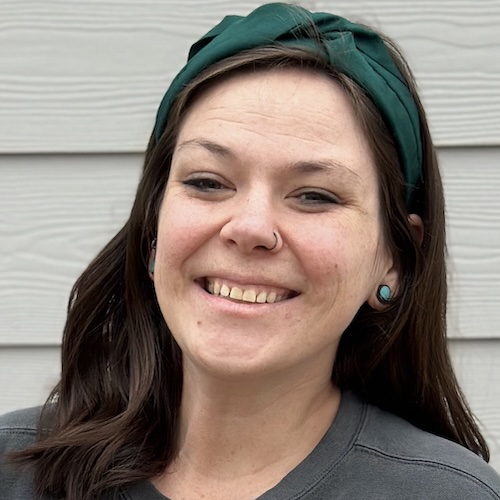
Awake brain surgery was the most daunting part of her treatment. The idea of being conscious during the procedure felt surreal, but online brain tumor communities offered guidance and reassurance. Though the surgery only allowed for a biopsy to avoid permanent damage to her right leg, Kelsi came out determined to focus on what matters. Recovery brought foot weakness, headaches, and fatigue, but also gratitude for her support system, from her parents and husband to friends who organized meal trains.
Today, Kelsi is on a new targeted therapy for IDH-mutant low-grade gliomas. Her goal is to delay chemotherapy and radiation therapy for as long as possible to protect her cognitive health, especially while raising her children. She knows her brain cancer is incurable, yet treatable, and she finds hope in advances in science and the possibility of new options ahead. Social media, therapy, and connecting with others facing similar challenges have been lifelines. She now shares her story online, offering support to others searching for hope beyond frightening Google results.
Through it all, Kelsi embraces her identity beyond the diagnosis, showing her children that brain cancer doesn’t define her. She focuses on what is important: love, presence, and authenticity.
Watch Kelsi’s video and read through her interview transcript below. You’ll take a deep dive into her story, including:
- How a young mom discovered that she had brain cancer even without warning signs
- Parenting two toddlers while recovering from awake brain surgery
- Why “not looking sick” can be both a blessing and a challenge
- The surprising way hip pain led to her life-changing diagnosis
- Finding community, hope, and identity with brain cancer
- Name: Kelsi N.
- Diagnosis:
- Brain Cancer (Astrocytoma with IDH Mutation)
- Grade:
- Grade 2
- Symptoms:
- None; tumor discovered by accident during brain MRI
- Treatments:
- Surgery: awake craniotomy
- Targeted therapy
This interview has been edited for clarity and length. This is not medical advice. Please consult with your healthcare provider to make informed treatment decisions.
The views and opinions expressed in this interview do not necessarily reflect those of The Patient Story.
I’m Kelsi
I have a grade two astrocytoma. I was diagnosed in July 2025.
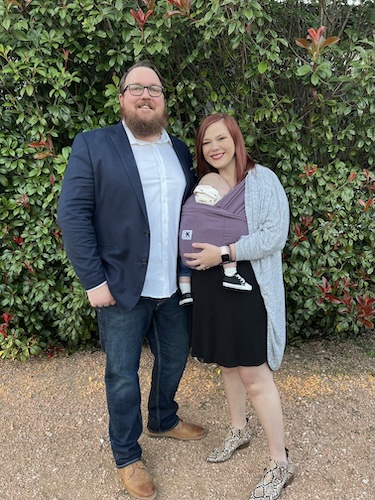
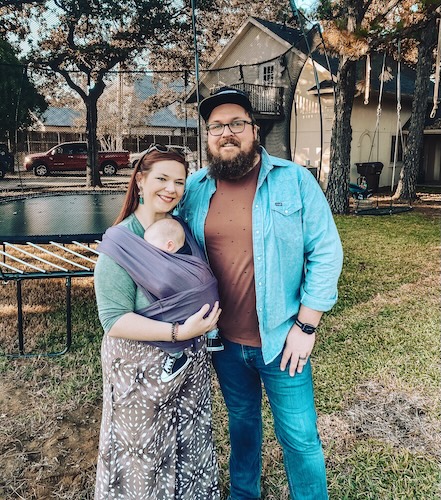
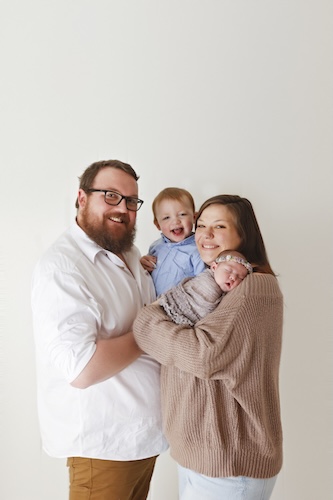
I have two kids, they’re two and four years old, and they are amazing. My husband and I enjoy going to concerts, and I enjoy reading. We’re a big music family, and we really enjoy music.
I had no symptoms
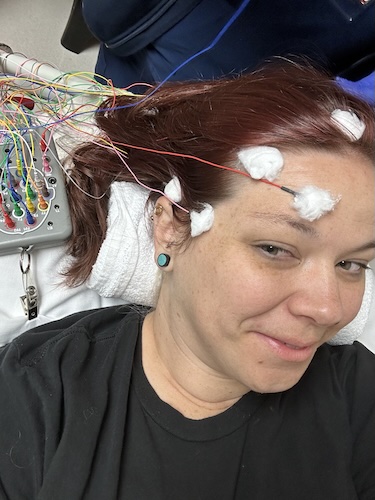
I did not have any red flags. I did not have any symptoms at all. My four-year-old was born in 2021, and he was 10 pounds. He was a big baby. And I had pubic symphysis dysfunction, which causes pain, often during pregnancy, due to excessive joint movement. My hips separated before birth, and it caused me hip pain during pregnancy. And then after pregnancy, I still had hip pain. So I went to the doctor in February of 2022 after he was born, still having hip pain. They did an MRI, saw something in my lower back, and wanted to do a full spine MRI. We did the spine MRI and found something in my spinal cord. They wanted to rule out Chiari malformation. So they did a brain MRI and we found my brain tumor.
How I reacted
I immediately went very pessimistic, got very dark. But the doctors here in town where I live were very reassuring, and I went to scans every six months here, but then, finally, my gut told me I needed to go do something else, because they were not brushing it off, but making it seem like it wasn’t a big deal. It could be bad, it could be good, we don’t really know what it is.
I told my husband in 2024, “Let’s go to MD Anderson and just get it checked out.” I was ready to know what it is or just get it behind us. And MD Anderson said that they saw growth on my MRIs that the doctors here locally did not see. And they wanted to do awake brain surgery.
I had another MRI with them in January of 2025, and there was a little bit of growth, and that’s when they seemed very concerned. So I remember my husband and I were in the room. We asked, “Is this brain cancer?” And the oncologist looked at us, and she said, “Yeah, it is.” And it was something that I had known that this tumor existed, but it didn’t have a name. I didn’t know it was cancer. January of this year was when it really hit home.
My husband and I both started crying. Our oncologist started reassuring us, saying, “It’s not your fault, there’s nothing that you could have done.” But also in the same mindset, I was optimistic that I hadn’t had any, I haven’t had any seizures, I haven’t had any headaches. All of this was totally incidental. So I felt even in that moment that I was in a good headspace.
After the appointment, my husband and I were in a daze. I usually text my parents after every appointment to update them. And so I texted them, and I was much more vague than usual, because they were watching the kids. I remember coming home to our house. My mom had the kids, and I told her about the findings face-to-face. And she put up a really strong front. She said, “Okay, well, whatever it is, we will get through it.”
I needed brain surgery
I knew I was going to have to be awake during the surgery. That, I think, was the hardest thing to try to come to terms with. The whole month of June, all I was thinking about was that I would be having awake brain surgery.
I watched a lot of videos. There’s a brain tumor group on Facebook of people who have had awake brain surgeries. I’m a very, very anxious person, and I was wondering if I would have a panic attack or something in the surgery. I was afraid I was going to mess it up. But the people in the Brain Tumor Facebook groups reassured me, and a lot of people had awake surgeries that were successful.
The night before the surgery, I was very, very nervous. Going into the operating room that morning was the strangest experience. It was like being in a dream and feeling that I’m going to wake up soon.
The procedure took about eight hours. I went to the hospital at around 6.30, entered the operating room at 7:00, and then I was out by 3.30 or 3.45.
My recovery
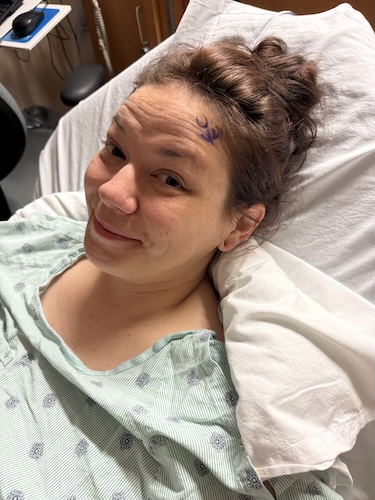
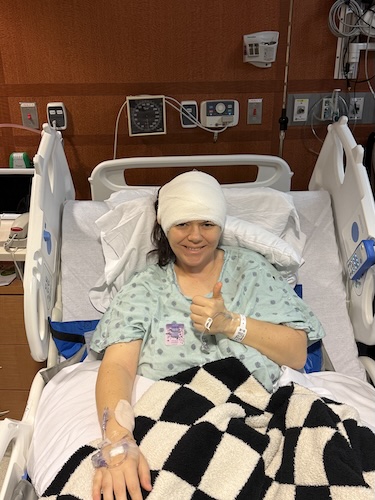
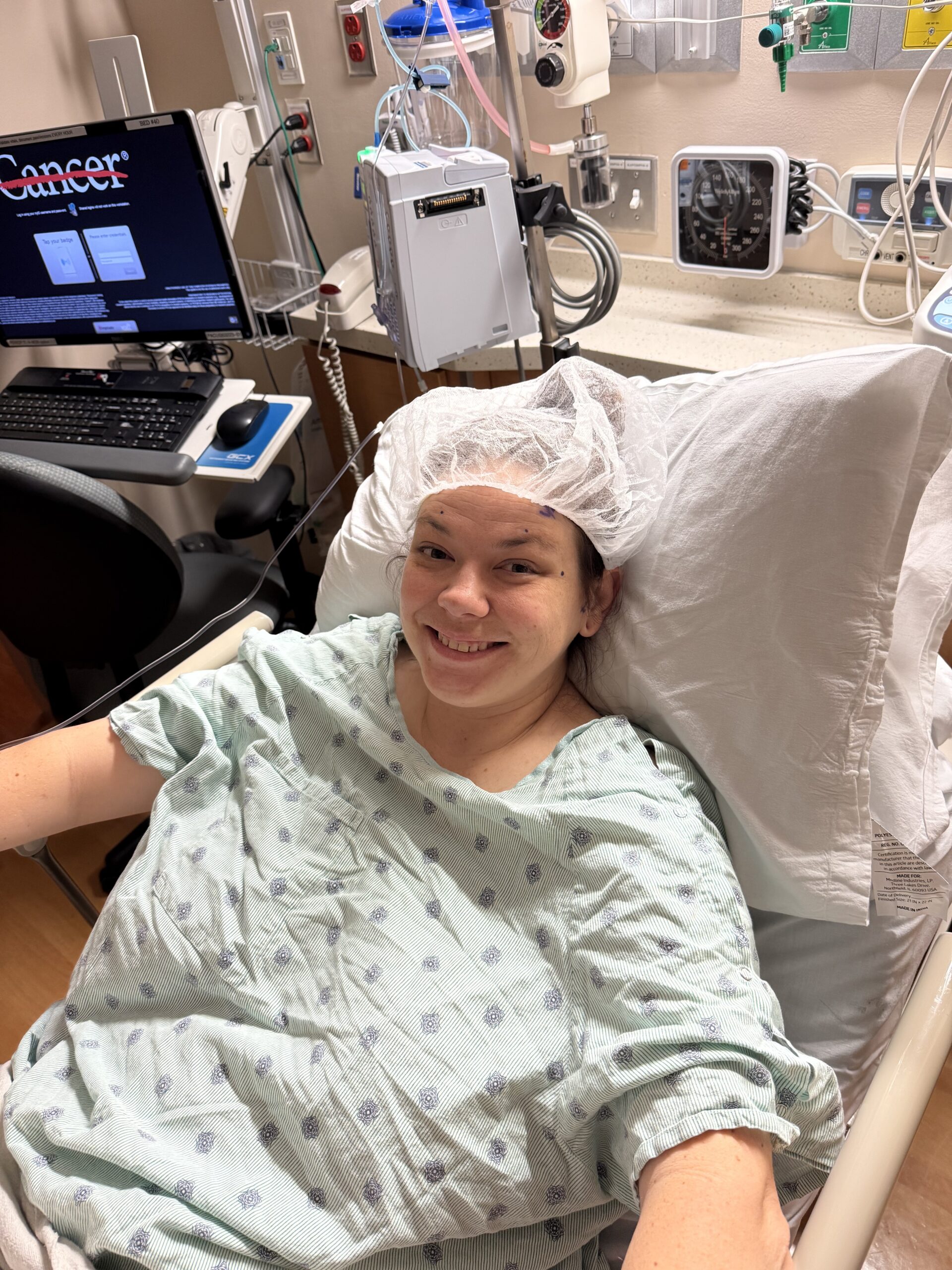
I was only in the hospital for two days. I went there for my surgery on July 2nd, and I left on July 4th.
My brain tumor is in my motor strip. So whenever they were in there, they knew that it could affect the right side of my body, and it did. And so we were only able to get a biopsy without causing permanent damage. So I still have most of my tumor left. But even just from the biopsy, touching it on the motor strip, I was unable to walk, or was unable to use my right leg and my right foot for a week and a half to two weeks. I had something called drop foot. I had a walker, went to physical therapy, and I could feel everything. If somebody touched my legs, I could feel it, but I just couldn’t lift my right leg. That was probably the scariest thing, second to surgery, my brain telling me to move my foot, and I couldn’t do it.
I did have headaches after the surgery. I still have headaches now, but they’re not nearly as prominent as they were. I got a fun little migraine mask that you put in the fridge that you put over your whole face. That’s still been a godsend whenever I get home from work. Headaches, and bright lights — it’s now more the latter than noise that triggers a headache.
My treatment plan
In August 2024, the FDA approved a drug called Vorasidenib, which is an IDH inhibitor. And my tumor is an IDH mutant grade two astrocytoma. And so this drug was curated for low-grade gliomas with the IDH mutation. And I was able to start that with hopes that that will push off the need for chemo radiation for as long as possible, so that I don’t have to have any cognitive side effects, since I’m so young, my kids are so young. But hopefully, it will buy me time. Because we did the watch-and-wait approach from 2022 to 2025. And then MD Anderson said, “No, it is showing a little growth.” But luckily, I was eligible for this drug.
I’m tolerating it really well. I’m fatigued, but I think that can be related to a lot of environmental factors as well. I think it’s also due to just being back at work and having two young kids. I think I’m just 11 weeks post-surgery; I counted yesterday. And I’m so tired from that procedure. But overall, I’m tolerating it really well.
It is incurable, but it’s treatable. It could mutate to a higher grade, a grade three or a grade four, but the hope is that the targeted therapy I’m on will keep it at bay for as long as possible. They told me that I couldn’t have a full resection without losing the total capability of my right leg. I feel like a lot of people with brain tumors have seizures, numbness, or tingling in their legs. And so I think that’s what was a big wake-up call too, with my not being able to use my foot because I hadn’t had any symptoms. This is like having brain surgery, which was the first thing that actually hurt my head. And then I lost the ability to use my foot for a week and a half. And I was like, okay, so this is the reality I’m facing.
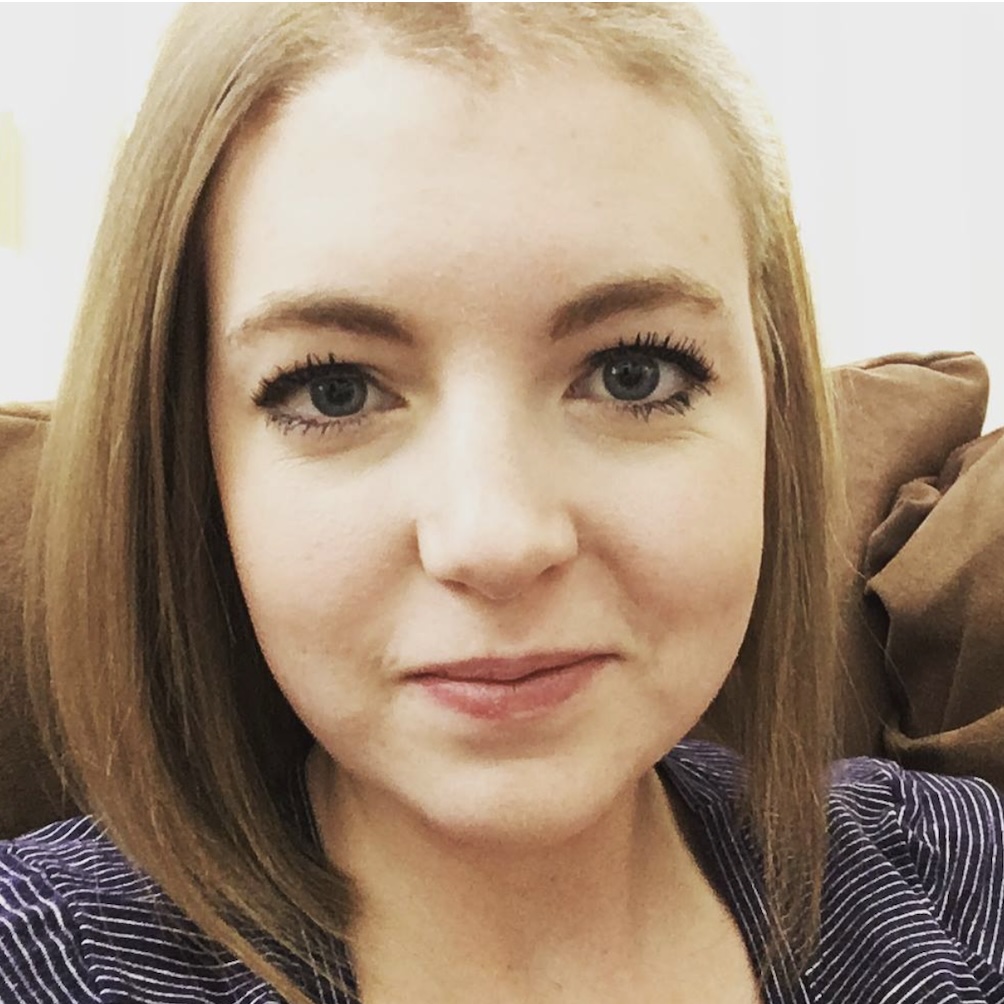
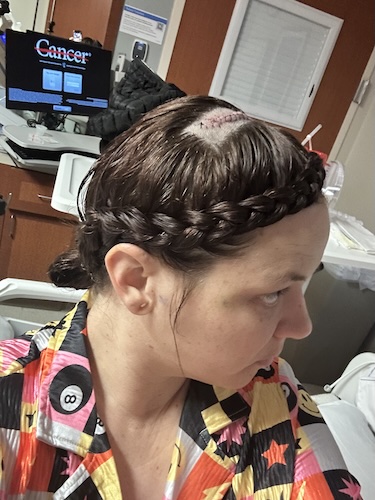
I’ve been wearing bandanas and stuff. But this is actually the first time I’ve worn my hair down without a bandana. And I was doing a thing on TikTok, and I was taking pictures because it looked like a little Chia pet, like the way it was growing in. That’s what my mom kept calling it, but now it’s grown in so much. It’s kind of folded over, but there’s a big line there.
How my diagnosis impacted my day-to-day
It has had a significant impact. I’d like to think that the brain cancer doesn’t define me. It just woke me up. I understand now what is important and what is not so important. As young women, we grow up comparing ourselves to other people and what we should do to fit in, who likes us, and friend groups. And now I think it was not a much-needed reality check, but it was definitely a reality check of what my purpose is. What is important? Like living my true, authentic self.
It has been difficult, but my four-year-old is very, very observant. And now that my hair’s growing back, he goes, “Mom’s boo-boo’s gone. Mom’s boo-boo’s gone.” And I go, “Yes, but…” And so we haven’t really explained to them that this will be an ongoing thing.
They knew that there was a boo-boo in my head. The doctor took it out. But now that I can lift it, and that I can pick up my kids, he keeps saying, “Your boo-boo’s gone. You can pick us up. Mom, are you okay?” They know I’m on medicine for my boo-boo. It’s been pretty difficult to navigate, but I think both of my kids are warriors, and they’ve been super responsive to my needs throughout this whole thing.
The most difficult part of my diagnosis
I think the hardest part was the unknown. From when I first found it, and I was on the watch-and-wait approach here, they didn’t seem like it was a huge deal. I just knew it existed. I didn’t have a name for it. But then, when I went to the cancer center in 2024, and they were alarmed, I think the waiting before finding out what it was was probably the hardest part.
I think I’ve realized what I value more, what is important to me. Relationships that I’ve maintained. Just wanting to be myself throughout all of this and show my kids that even though there is something rather big hanging over my head, I don’t let it define me. I’m still going to show up, I’m still going to be a good mom, a good employee, a good friend, a good wife, a good partner, all of that.
It is a lot. I’ve really had to learn to prioritize what’s important and what really means something to me, and what is going to help me live my fullest life, because it will likely be cut short by brain cancer. As well as what I can do to have an impact while I’m here.
What my support system has looked like
My parents have been incredible throughout the whole thing. They took care of my kids while I was in surgery. They drove my kids to Houston and stayed in a hotel. And then my husband left the hospital room and went downstairs to the lobby of the hospital. My parents came up, so my kids were there, but didn’t have to see me like that. So my parents have been my greatest support system.
My brother started a GoFundMe for me, which was incredible. One of my really good friends from work had a meal train for me, and that was life-saving, because I still haven’t cooked at all. Trying to bend over and pick up things, and having to maneuver, and doing so many tasks at once. I didn’t realize how much it would affect me, and so that was amazing.
I’m in a group text with my best friends. Every morning, like the morning of surgery, they were texting me, and my husband was able to keep everybody informed. I know it’s hard for me, but I can’t imagine how hard it is for my husband right now. Having to see the unknown. We don’t know what’s gonna happen. And so I don’t envy his position.
How I’ve found support online
I feel like the first thing you do when you get a diagnosis like this is to Google. And that can be very detrimental to your mental health. I Googled, and I let myself get to a very dark place for a couple of weeks after I found out that it was likely brain cancer. And I sat in the darkness of my mind, and I was like, “Okay, this is terrible.” And then I went, “But I’m sure this has happened to other people.” And then I started getting on social media, and there are so many Facebook groups and young people my age and in their mid- or early thirties who are going through something very similar. And then some people had it when they were in their thirties and are still thriving and doing really, really well. And so that kind of impacted me.
I feel like when most people think about brain cancer, they think it’s a death sentence. When I found out, I was with a newborn and, at the time, a two-year-old. And I got really dark, but it gave me some hope and some realistic expectations. And I’ve gone to therapy, which has been awesome.
I feel like when I talk about others and want to do stuff for others, I’m very optimistic. But for myself, I feel like I get very pessimistic about reality. My therapist keeps telling me, “Well, the odds of the worst case scenario happening are the same odds of the best case scenario happening.” But immediately, you always think, “This could happen. It could be this.”
What I want others to know
You cannot compare your situation to others. If you’ve met one person with a brain tumor, you’ve met one person with a brain tumor. Not every case is the same. I now have a core group of four or five girls that I talk to daily. I met them through this Facebook group. We’re going through the same things, but all of us have had different symptoms, different responses to treatment, and so on.
The community is a very small, very unfortunate place to be in, but it has been super supportive. They absolutely know what’s going on. When I started posting on TikTok, I found some people there who were going through the same things and could give good advice, like what to pack for brain surgery and what to do after brain surgery. I was like, “That’s genius.” So I found people who were in the same situation as me, and then I started posting. As. of now, I’ve had five or six people reach out to me on TikTok who are going through the same thing. “I’ve exhausted all my efforts on Google. I’m in a really dark place right now. Your story gives me help.” I know when I reached out, when I first got diagnosed, I reached out to other people who had gone through it. I was very happy that they responded. If I can do that for somebody else, I feel like I will be pretty fulfilled.
Google’s outdated, don’t listen to Google, don’t read Google. If you Google my cancer now, I think it says a patient has a five- to seven-year prognosis, which is jarring. Being where I am right now, I feel like I’m in a good time for science. And that gives me help. And then the treatment that I’m on gives me hope that there will be different options in the future before I have to do chemotherapy and radiation.
Since I didn’t have any symptoms, I wouldn’t have known I had cancer had I not had hip pain after I gave birth to him. I’m indebted to my son forever; he definitely saved my life. I’d be here now with a four-year-old and a two-year-old and not even know I had it. So I thank him for that.
Inspired by Kelsi's story?
Share your story, too!