
A Rash Only My Wife Worried About Turned Out to Be BPDCN, an Ultra-Rare Blood Cancer
Jim had been tremendously itchy for weeks before he thought much of it. His wife noticed a rash that she didn’t like from the day she saw it. It was one spot, high on his back. A dermatologist gave him a cream and sent him home. It took a primary care doctor telling him, “I’ve just never seen anything that looked like that before,” and a second round of blood work, before anyone pushed to biopsy it. The biopsy came back positive for blastic plasmacytoid dendritic cell neoplasm (BPDCN), an aggressive and rare blood cancer. The diagnosis meant nothing to Jim when his doctor said it, as he had never heard of it before.
Edited by: Katrina Villareal
What followed was six days that weren’t very optimistic. Jim tried to look calm for his kids while he quietly researched what BPDCN was and where in the country to get treated for it. Everything he found kept pointing to the same two places: Dana-Farber in Boston and UT MD Anderson in Houston, so within a week of his diagnosis he was on a plane to both. He liked his doctor in Boston immediately. Then, in Houston, the vice chair of the leukemia department walked in and told him his partner, Dr. Naveen Pemmaraju, “… is probably the world’s expert on this diagnosis,” and had come in that day just to meet him.
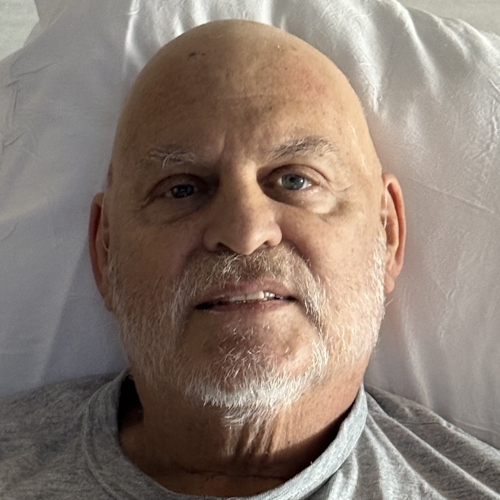
Jim, however, ended up exploring a third option: a doctor closer to home at Penn, upon the recommendation of the Boston specialist. She told him plainly that whichever hospital he chose, he’d be living near it for a year. That spring, he started targeted therapy for BPDCN. Within one cycle, his rash was gone, and he was already in remission.
We interviewed Dr. Pemmaraju for a BPDCN webinar to explain the current treatment options. He explains that we are entering “a golden era of personalized BPDCN therapy.” Before, there was one approved treatment, and everyone got it. Now there are two, with different tradeoffs. Tagraxofusp (Elzonris), the first drug approved for BPDCN, requires the first cycle to happen inpatient, with close monitoring. The newer option, pivekimab sunirine (Decnupaz), which was just approved in 2026, works differently and can be given outpatient from the start. As Dr. Pemmaraju put it, “We’re excited to have two monotherapy approvals that you can choose either one, depending on the patient’s preference, their comorbidities, and some contraindicating factors.”
In August, Jim had a stem cell transplant that he describes, almost implausibly, as “a nonevent,” even eating a Philly cheesesteak while it ran. The real fight came three days later: a stretch of nausea and appetite loss that kept him from eating solid food for over a month, and a hospital stay that only ended when he could keep down 1,000 for two consecutive days.
When asked what got him through it, he doesn’t point to the treatment first. He points to his wife, who ran his infusions at home with no medical background and never complained. “My advice to anybody who intends to get sick,” he says, “is marry well.”
Watch Jim’s video or read the edited transcript of his interview to find out more about his story:
- A rash that keeps changing is worth a biopsy, even if the first two doctors aren’t worried. Persistent skin changes are one of the few visible warning signs of BPDCN.
- Getting a second opinion, or even a third, is worth it. Jim called two cancer centers within days of his diagnosis and had appointments at both within a week. He credits that speed and the range of opinions it gave him with helping him make the right decision for him.
- A hard treatment day doesn’t mean that the treatment isn’t working. Jim’s stem cell transplant itself was a nonevent. The real difficulty came three days later, with side effects that kept him from eating for over a month. Progress and difficulty can show up on different days.
- Recovery depends on more than medicine. Jim spent his first three months at home, seeing only his wife, son, and dog while his immune system started to rebuild. He’s direct about who got him through that stretch: his wife and care partner.
- We are in the “golden era” of BPDCN treatment options. Dr. Pemmaraju, leading BPDCN oncologist and researcher, explains how we are in the “golden era” of targeted therapies with the arrival of pivekimab sunirine.
Jim’s Diagnosis Facts
- Name: Jim T.
- Diagnosis:
- Blastic Plasmacytoid Dendritic Cell Neoplasm (BPDCN)
- Symptoms:
- Persistent itching
- Rash on the upper back
- Treatments:
- Targeted therapy: tagraxofusp
- Allogeneic stem cell transplant
Program Partner

Thank you to Blood Cancer United for their partnership. They are here for you with information about clinical trials, resources, and dedicated support through their Information Specialists.
This is not medical advice. Please consult with your healthcare provider to make informed treatment decisions.
We left the office somewhat stunned… I knew it was something serious, because I could tell my wife’s expression had changed totally.
Jim T., Blastic Plasmacytoid Dendritic Cell Neoplasm (BPDCN) Patient
The diagnosis that changed everything
Jim: He said, “I have some concerning news. The biopsy came back positive for BPDCN,” which meant nothing to me. He said it’s a very aggressive and very rare blood cancer.
We left the office somewhat stunned, not having any clue what that meant at that point. I remember stopping on the way home to get something to drink. The moment I got back into the car, I knew it was something serious, because I could tell my wife’s expression had changed totally.
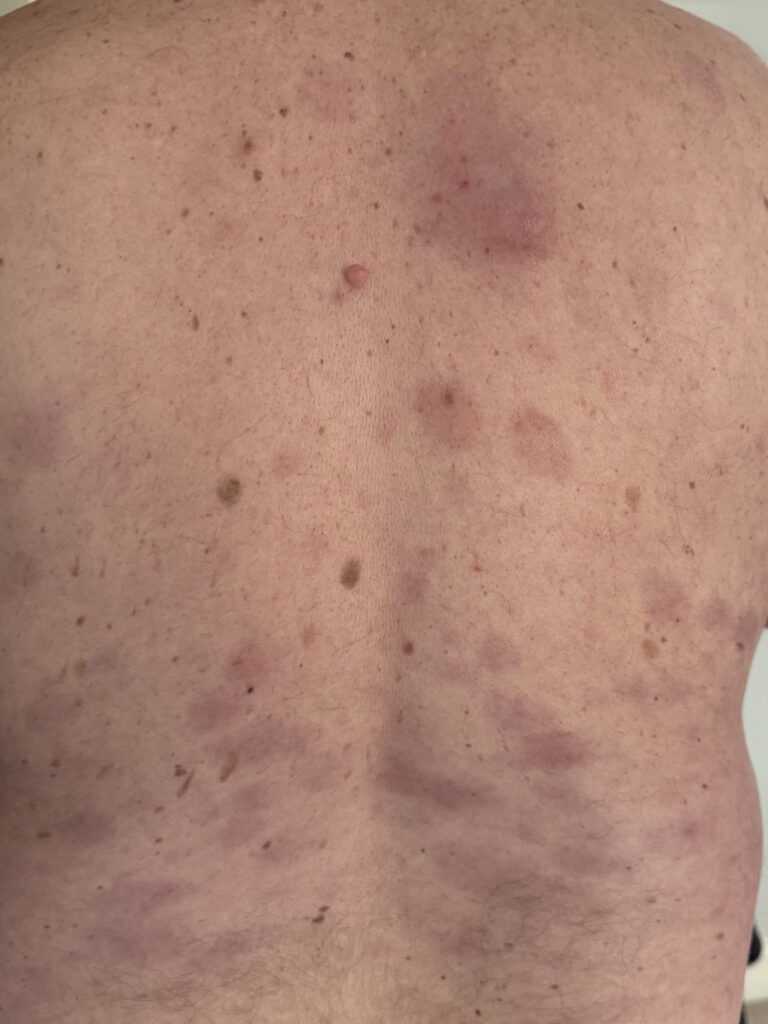
In the fall of 2024, I noticed that I was tremendously itchy, but I didn’t do much about it. Then in late December, my wife noticed a rash in one spot at the top right of my back. She didn’t like it from day one, but I blew it off, as I’m apt to do. She didn’t like the way it looked. Finally, I went to a dermatologist in early February, who looked at it and told me it was nothing. He gave me some cream for the itchiness and to hopefully help with the rash.
He continued not to be at all concerned about this rash, even after it had spread throughout my back. The last day of March, my wife and I went to my primary care physician to have him take a look at it, because it had gotten significantly worse and spread to other areas of my body. He said, “I don’t want to worry you, but I’ve never seen anything that looked like that before.”
He ordered a complete set of blood work and said, “Go back to your dermatologist and tell him he has to do a biopsy on that rash.” I went through the blood work on April 2nd and it came back completely normal, so we relaxed a little. I saw the dermatologist a week later for the biopsy. Even at that point, he argued with us, “I don’t think it’s necessary.” We felt, “Let’s be safe. Let’s do the biopsy,” so we did it.
I did a lot of research, and everything kept coming up with the same two locations: Dana-Farber in Boston and UT MD Anderson in Houston.
Jim T., Blastic Plasmacytoid Dendritic Cell Neoplasm (BPDCN) Patient
The research spiral
Jim: I called my PCP from the car to give him the diagnosis, and he had never heard of it either.
I assumed my wife must have Googled it while I was going into the store. She didn’t say much about it, but it was giving her things like my life expectancy was between 8 and 12 months, which made me more concerned. I stopped researching what it was and began researching where it made the most sense to get treated.
I did a lot of research, and everything kept coming up with the same two locations: Dana-Farber in Boston and UT MD Anderson in Houston. I was diagnosed on a Thursday; by Sunday, I’d pretty much made up my mind that those were the two places I wanted to look into.
My initial question was: Do I have a chance of surviving? I started reading. I read a little, didn’t like what I was reading, concentrated on where I wanted to go for care, and I stopped reading more once we’d made that decision.

For the first six days, I wasn’t very optimistic. I was trying to appear more optimistic, especially for my children. My mom’s still alive too, so when talking to my sister, my kids, and my mother, I tried to keep a positive face on. But it was difficult, frankly, because I didn’t know enough about it at the time, and what I knew was lousy.
The vice chair of the leukemia department, who walked in, shook my hand, and said, ‘I know you’re supposed to see me today, but my partner, Dr. Pemmaraju, is probably the world’s expert on this diagnosis. He wasn’t supposed to be here, but he came in just to meet with you.’
Jim T., Blastic Plasmacytoid Dendritic Cell Neoplasm (BPDCN) Patient
Meeting the world’s expert on BPDCN
Jim: From what we’d read, getting in sooner rather than later seemed to be important. I called Dana-Farber on Monday at 9 a.m. They asked what the diagnosis was, and said I could get an appointment with Dr. Marlise Luskin that Wednesday. I was tremendously thrilled, and also scared that I was able to get in that early.

The same thing happened with UT MD Anderson. I ended up getting an appointment for Thursday. I’d asked for Dr. Naveen Premmaraju, who, if there was one expert on this, seemed to be him. But they said, “I can’t get you in to see him until the end of May. You can see his boss, the chair of the leukemia department, on Thursday, though.” I thought that was a good alternative.
We flew up to Boston for our Wednesday appointment, got to the hospital, and had blood work done. By 10 a.m., I met with a dermatologist who examined it. They did another biopsy at Dana-Farber. Then at about noon, I met with Dr. Luskin, who I liked immediately. She was very positive. She basically said, “From looking at your blood work and looking at you, I would guess that you’re in the early stages of this.” I left with a little bit of hope. I certainly felt better that night than I had in the morning.
That afternoon, I got on a plane and went to Houston. I went through a similar routine at 9 a.m. I had blood work done, then I had a 10 a.m. appointment with the vice chair of the leukemia department, who walked in, shook my hand, and said, “I know you’re supposed to see me today, but my partner, Dr. Pemmaraju, is probably the world’s expert on this diagnosis. He wasn’t supposed to be here, but he came in just to meet with you.” I was thrilled. I met with Dr. Pemmaraju for close to an hour and a half, I’d say.
Nobody is necessarily thinking about a rare disease upfront, but if something is persistent, changing in size, shape, or color, get it checked.
Dr. Naveen Pemmaraju, Hematologist-Oncologist
What BPDCN Actually Is
Jim’s article includes portions of a webinar with Dr. Naveen Pemmaraju of UT MD Anderson Cancer Center, discussing BPDCN treatment options held soon after a second targeted treatment came out for patients.
Dr. Pemmaraju is the physician who led the clinical trials for both FDA-approved BPDCN targeted therapies, and is joined by blood cancer patient advocate Andrew Schorr for a free, in-depth conversation built for patients and care partners navigating this disease right now.
Dr. Naveen Pemmaraju: We should start with blastic plasmacytoid dendritic cell neoplasm (BPDCN). As you mentioned, it’s a rare blood cancer, maybe even ultra-rare. The latest estimate by my group is that it only affects 500 to 1,000 Americans per year. In any of these rare, esoteric blood cancers, as you and I know, sometimes there’s an underdiagnosis problem, meaning people haven’t even thought about the diagnosis. There’s a misdiagnosis problem. It looks like acute myeloid leukemia (AML) or lymphoma, which are more common.
Jim: One of the pieces of advice Dr. Luskin gave me was: I’d love to treat you. I think there’s going to be a good chance of success. I see you live right outside of Philadelphia; I know the doctor at Penn Medicine, Dr. Keith Pratz. He’s excellent and he’s going to use the same protocol that I would. Whether you go here, Houston, or Philadelphia, you’re going to be wherever you get treated for a year, so you have to be within the vicinity of the hospital. Use that to make your decision. You’re either going to be in Boston for a year, in Houston for a year, or at home when you’re not in the hospital.”
That was tremendous advice. We flew home on Friday from Houston, and I was torn. My wife, in retrospect, was quiet and wanted me to make the decision.
Dr. Pemmaraju: Nobody is necessarily thinking about a rare disease upfront, but if something is persistent, changing in size, shape, or color, get it checked.
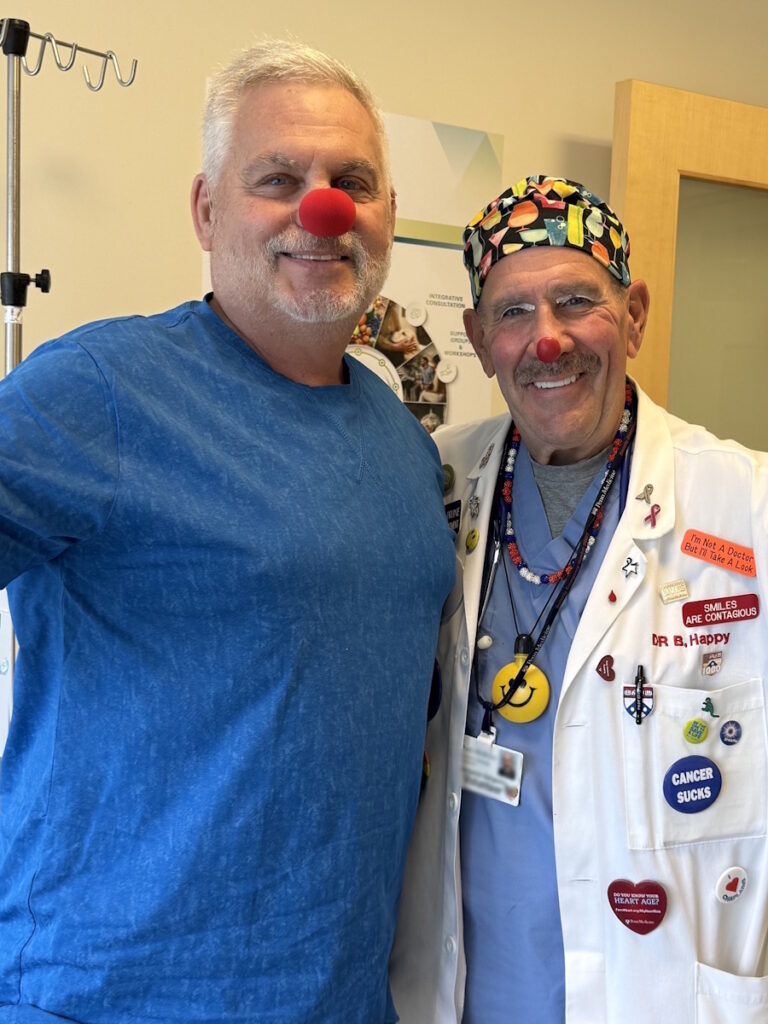
Jim: The following Tuesday, I saw Dr. Pratz for the first time at Penn and had a very similar conversation as I had with Dr. Luskin. But it was an incredibly hard decision. You’re trying to decide for your life.
Dr. Pemmaraju: Once something is not common, look for who specializes in the uncommon because for them, the uncommon is common.
No matter how expert the person is, whether it’s me or anybody else, I encourage you to get a second or even a third opinion, if it’s necessary.
Dr. Naveen Pemmaraju, Hematologist-Oncologist
The case for a second opinion
Jim: When you have something that’s life-threatening, you want to know all the viable options, so that you can make what you think is the best decision. If it’s anything serious, I would very much recommend going to at least two people. I ended up going to three.
Dr. Pemmaraju: This is very important. I want each patient to know this: It’s your body, your life, your journey, and therefore, it’s your choice. No matter how expert the person is, whether it’s me or anybody else, I encourage you to get a second or even a third opinion, if it’s necessary.
It’s a great idea to get multiple opinions because sometimes, the personality may not click. Never feel embarrassed, lonely, scared, or worried about seeking a second opinion. “What’s my doctor going to think? What’s this person going to think?” It’s your body, your life, and your journey, so it’s your choice.
Jim: For BPDCN, you could go to Dana-Farber’s website. I’ve honestly been on that more than I’ve been on UT MD Anderson’s. Blood Cancer United is another good source if you have any type of blood cancer. Those three would be excellent resources. They gave me a little more hope than I had.
Dr. Pemmaraju: I actually think it’s okay to turn to the internet, but you have to be careful of the sources that are on there. You’re not alone. When I first became a doctor a quarter of a century ago, there were rare diseases that people never heard of; that’s almost not the case anymore. If you go online, usually you’re going to find a specialist somewhere in the world who’s working on what you have.
Any time we mention the excitement of new therapies, we must always, in the same breath, mention the new toxicities. And they are there.
Dr. Naveen Pemmaraju, Hematologist-Oncologist
A new era of BPDCN treatment
Dr. Pemmaraju: What is the end goal of the therapy? If the end goal is curative intent, then your next move is going to be a stem cell transplant. You want to optimize the therapy that’s going to get you to transplant with the least amount of toxicity and the most amount of verve going into it.
Jim: I would say there’s hope. I’m talking to you, so there’s hope. It’s not the death diagnosis that it probably was 10 years ago, if you got it.
Dr. Pemmaraju: We have now entered a golden era of personalized BPDCN therapy. We just didn’t have it before; everyone was treated the same way.
There were no approved targeted agents and our group was able to lead the first one. We got that approved in December 2018. That was a huge breakthrough for our field and it put us on the map. But I’m glad to tell you that since then, we have had a second agent that was approved in May 2026. It’s also FDA-approved as a single agent in all lines of therapy. In addition to that, we’ve now moved into combination regimens in our field.

Any time we mention the excitement of new therapies, we must always, in the same breath, mention the new toxicities. And they are there. With tagraxofusp or TAG, the first-in-class CD123, the diphtheria toxin-modified agent, there was an FDA black box warning, appropriately, for a potentially life-threatening complication called capillary leak syndrome (CLS). That’s very important.
We’re excited to have two monotherapy approvals that you can choose either one, depending on the patient’s preference, their comorbidities, and some contraindicating factors.
Dr. Naveen Pemmaraju, Hematologist-Oncologist
Dr. Pemmaraju: It can happen quickly at early onset, usually in that first week of therapy. Mandatorily, we need to have patients hospitalized for close monitoring.
The second drug, the pivekimab sunirine or PVEK, also garners an FDA black box warning and appropriately so. These are major warnings for providers for liver toxicity or hepatic dysfunction. Now, it also targets CD123, so with this drug, there are two things I want us to watch out for. The liver is important, so monitor the liver function tests. What’s interesting about this one is that it’s safe enough to be given outpatient from the beginning. That’s novel and interesting.
It’s interesting that in a rare disease, we mix, match, and borrow depending on the patient’s fitness. But we’re excited to have two monotherapy approvals that you can choose either one, depending on the patient’s preference, their comorbidities, and some contraindicating factors.
Get into that first remission. Get central nervous system prophylaxis. Get to an allogeneic stem cell transplant, if you can.
Dr. Naveen Pemmaraju, Hematologist-Oncologist
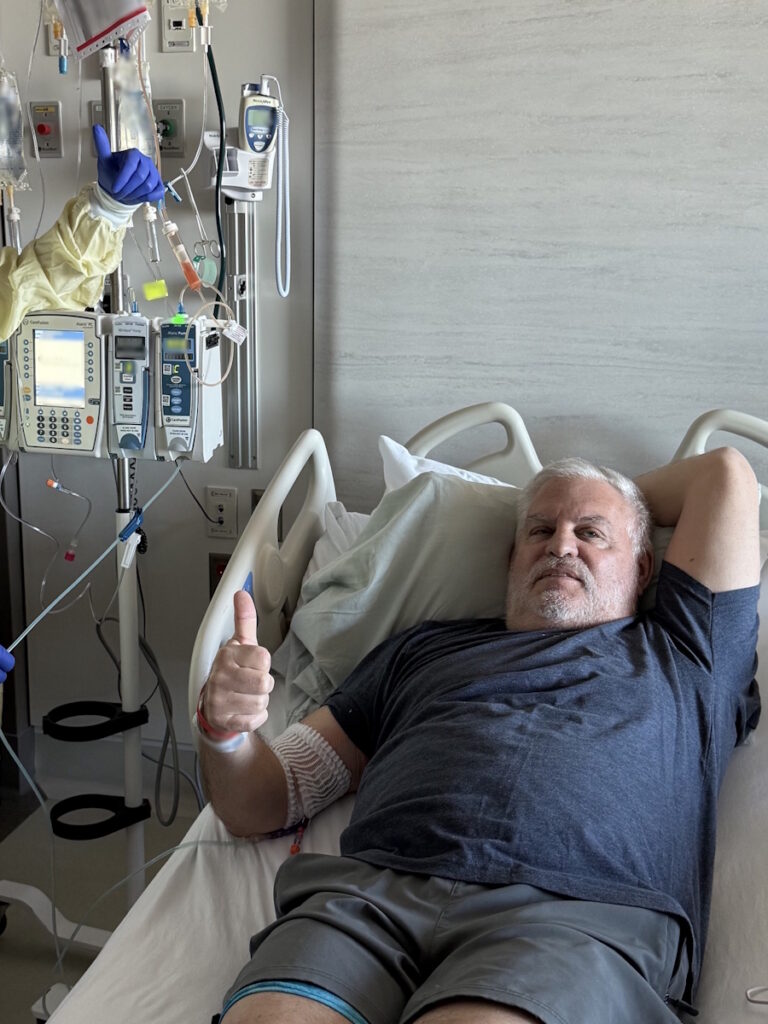
Jim: Good news: Between cycles one and two, my doctor confirmed, given the complete elimination of the rash and no more itchiness, that after cycle one, I was already in remission. He gave me the wonderful news that I had 275 total (10 out of 10 matches), which was the biggest number he’d ever seen.
Dr. Pemmaraju: We’ve optimized the allogeneic stem cell transplant. That was a very scary and difficult thing to do for some of our patients 20 years ago when I first started in this. Now, we think that almost every patient – if not every patient – has a potential donor. We’re able to do it for older patients and more centers can do it. The paradigm for BPDCN is targeted therapy plus other therapies, if you’re able to get them. Get into that first remission. Get central nervous system prophylaxis. Get to an allogeneic stem cell transplant, if you can.
Jim: The transplant happened on August 19th from 4 p.m. to 6 p.m. It was a nonevent. I had a Philly cheesesteak during the transplant. I felt fine for the next two days.
The hardest part post-stem cell transplant
Jim: On day three, I had diarrhea, chills, and a complete loss of appetite. I didn’t eat anything from day three to day 38. I was getting all of my nutrition through an infusion. The fact that I wasn’t eating wasn’t helping. I finally had a conversation with the doctor, and she said, “If you can eat and keep down 1,000 today and tomorrow, I’ll send you home on Saturday.” Finally, by Saturday, I got back home.
A great part of my success is due to the care that she gave me and continues to give me.
Jim T., Blastic Plasmacytoid Dendritic Cell Neoplasm (BPDCN) Patient
Where I am now
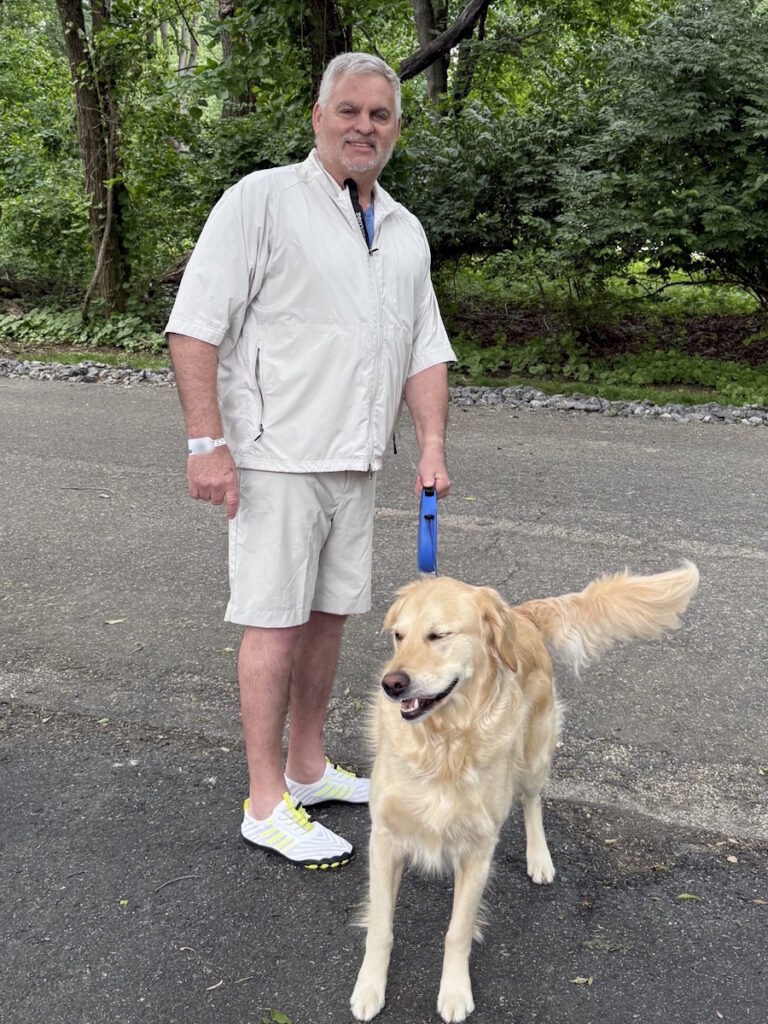
Jim: Basically, for the first three months, the only time I left home was to go to Penn. You basically have no immune system at this point. The only ones at home were my wife, my son, and my dog. Those were the only three beings I was seeing for that first three-month period.
I would say the most critical part of my success is the person that I married. My advice to anybody who intends to get sick is to marry well. She was wonderful when we got back home doing the infusions, which can be scary. She doesn’t have the medical background, but she did it flawlessly and never complained. I think a great part of my success is due to the care that she gave me and continues to give me.

Program Partner
Thank you to Blood Cancer United for their partnership. They are here for you with information about clinical trials, resources, and dedicated support through their Information Specialists.
This interview has been edited for clarity and length. The views and opinions expressed in this interview do not necessarily reflect those of The Patient Story. This content does not replace professional medical advice.
Inspired by Jim’s story?
Share your story, too!
Hear from people living with rare cancers
Real experiences with diagnosis, treatment choices, side effects, and life beyond rare cancers — in their own words.

Leave a Reply