
Jessica’s BRCA2 Genetic Mutation Led Her to Catch Her HR+ Breast Cancer Early and Build the Family She Feared She’d Never Have
Thirteen-year-old Jessica watched her mom get diagnosed with ovarian cancer, then her aunt was diagnosed with breast cancer the year after. Jessica’s grandmother had already died of breast cancer. By the time she was old enough to understand what her family was facing, breast cancer and the BRCA2 gene mutation were already woven into her life. Nine months after her mom passed away in 2008, Jessica decided to get tested for BRCA2 gene herself.
Interviewed by: Taylor Scheib
Edited by: Chris Sanchez
In 2019, at 33, a routine screening mammogram, part of the surveillance she’d followed since her BRCA2 diagnosis, turned up a small spot doctors said looked suspicious. Two biopsies and an agonizing few days later, Jessica learned it was hormone receptor-positive breast cancer.
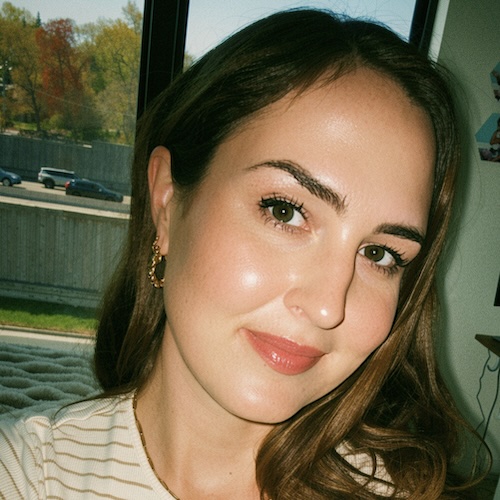
Even though a full mastectomy wasn’t strictly necessary at her early stage, Jessica moved back home from San Francisco within about six weeks of her diagnosis, to be closer to a clinic she trusted and a support network she needed. She chose a full mastectomy and, as a single woman at the time, reconstruction: decisions she’d already been planning around her BRCA2 risk long before cancer made them urgent.
Her BRCA2 mutation, identified back in 2008, is the reason her cancer was caught so early. The gene mutation put her lifetime risk for breast and ovarian cancer as high as 80%, and the screening it required found her cancer while it was still small. Recovery brought its own chapter: about five months between her mastectomy and reconstruction, complicated by the COVID-19 pandemic, and a revision surgery years later for a common implant issue.
Today, Jessica is nearly seven years cancer-free. She’s married with two daughters, conceived naturally after two miscarriages. She froze her eggs before a recent surgery to remove her fallopian tubes and one ovary, keeping the door open to a third child while she and her care team decide on a hormone therapy plan. She still gets annual mole checks, still compartmentalizes the fear that never fully goes away, and still calls each day a gift, the same words her mom used to say.
Watch Jessica’s video and read the edited transcript of her interview to learn more about her story.
- Family history can be a warning system. Jessica’s mother, aunt, and grandmother all had breast or ovarian cancer, and that pattern was enough for her to seek out BRCA2 testing on her own, just nine months after her mother’s death.
- A genetic test result can change what’s possible. Testing positive for BRCA2 at 22 meant Jessica started biannual screening in her late twenties, screening that caught her breast cancer while it was still small.
- Reconstruction decisions are personal, not just medical. Jessica decided on a full mastectomy and reconstruction based on how she wanted to feel in her own body afterward, not only on what her cancer required.
- Dating after cancer doesn’t have to wait. Jessica met her husband between her mastectomy and reconstruction surgeries, and told him about her cancer on their second date.
- Building a family after BRCA2 involves more choices, not fewer. Jessica and her husband chose to try to conceive naturally rather than pursue IVF with embryo screening, and later froze her eggs before a surgery to remove her ovaries.
- Managing risk doesn’t end with treatment. Years after her mastectomy, Jessica is still weighing decisions about her remaining ovary and hormone therapy, and she manages the ongoing fear by compartmentalizing rather than carrying it every day.
Jessica’s Diagnosis Facts
- Name: Jessica L.
- Age at Diagnosis:
- 33
- Diagnosis:
- Breast Cancer
- Biomarker:
- HR
- Mutation:
- BRCA2
- Symptoms:
- None; discovered during a screening mammogram
- Treatments:
- Surgeries: full mastectomy, breast reconstruction, breast revision surgery, salpingectomy, single oophorectomy


This is not medical advice. Please consult with your healthcare provider to make informed treatment decisions.
- Jessica’s Diagnosis Facts
- A family history of loss
- Getting tested for BRCA2
- Screening and the long wait
- Living with it in the back of my mind
- A suspicious mammogram
- Diagnosis and decisions
- Choosing a mastectomy and reconstruction
- Meeting my husband
- Deciding to remove my ovaries
- Compartmentalizing to get through the tough days
- What I’ve learned
- My message to others
- Hear from people living with hormone receptor-positive (HR+) breast cancer
A family history of loss
My name is Jessica, and I created the Modern BRCA Mom platform. I was diagnosed with breast cancer in 2019, and I also carry the BRCA2 gene mutation. I found out I was positive for BRCA2 back in 2008, after my grandmother, my mom, and my aunt all passed away from breast and ovarian cancers.
My story goes back a long way. My mom was diagnosed with breast cancer when I was 13, and the year after that she was diagnosed with ovarian cancer. My aunt was diagnosed the following year, also with breast cancer. Both of their diagnoses came after my grandmother had already passed away from breast cancer. My mom and my aunt both battled for six to seven years before they died.
By the time I was facing my own diagnosis, I already had a long history with this disease, and I knew our family’s risk was incredibly high. Not long after my mom passed away, I learned about BRCA testing. I decided almost right away, about nine months after my mom died, that I wanted to be tested for the gene.
Getting tested for BRCA2
The doctors who had been treating my mom before she passed gave us information about this new BRCA testing. At that point, none of us had ever heard of BRCA. We eventually learned it’s a genetic mutation that puts you at very high risk, up to 80% for breast and ovarian cancers over your lifetime, if you carry it. (Editor’s Note: According to the National Cancer Institute, over 60% of women who inherit a harmful change in BRCA1 or BRCA2 will develop breast cancer, and from 39% to 58% of women who inherit a harmful change in BRCA1 and 13%–29% of women who inherit a harmful change in BRCA2 will develop ovarian cancer.) Beyond that, my younger sister, who’s five years younger than me, and I didn’t know much more.
But seeing the deaths in my family, my instinct was to go into the next decades of my life being as proactive as I possibly could, coming from a defensive standpoint rather than a reactive one. So I got tested not long after my mother’s death from ovarian cancer in 2008. My sister was tested in 2014, and she’s also BRCA-positive.
Back in 2008, the test itself was a blood draw, and genetic counseling was required before the blood work and when the results came back. When I got my results, I was in the clinic with my dad and my sister. Hearing that it was positive was shocking, even though I knew our history. I’d had this idea in my head that I looked more like my dad, so maybe I didn’t have it. I was 22 at the time, and I think part of me also believed that even though I’d seen so much death in my family from breast and ovarian cancers, it still wouldn’t happen to me. When I got the positive result, I was shocked, and there was a lot of emotion tied to it because of everything BRCA meant in my family’s history.
Screening and the long wait
Because I was so young when I got my positive BRCA result, I was told I had a few years before I needed to start screening, like annual mammograms and pelvic ultrasounds. I started that screening in my late 20s. It happens about every six months and includes blood work, pelvic ultrasounds, mammograms, and sometimes MRIs. (Editor’s Note: The National Comprehensive Cancer Network (NCCN) Guidelines recommend that people with inherited BRCA2 mutations begin breast cancer screening at 25, or earlier based on the youngest age of breast cancer in their families. Clinical breast exams should be done by a doctor every 6-12 months with yearly breast MRIs until age 75. Yearly mammograms start at age 30, but if MRI is not available, they should begin at age 25. Routine ovarian cancer screening using transvaginal ultrasound has not shown benefit and is not recommended.)
By the time I was 33, it was because of those screenings that we caught my breast cancer very early. Deciding to be tested for BRCA is ultimately why I’m probably sitting here right now. I have a strong family history of lethal breast cancer, and I happened to be born at a time when BRCA testing had just become available. That’s what saved me, being diagnosed so early. It’s led to me being cancer-free for almost seven years now; it will be seven years on September 20th.
Living with it in the back of my mind
Looking back, and considering that I have a background in psychology (I have my master’s in marriage and family therapy), I try to look at my own experience with some objectivity.
My worldview has always been shaped by the fact that cancer can happen at any moment, and you can die from it. Having family members diagnosed when I was 10 years old, I have never lived my life without having it in the back of my mind. It has always been there, and it’s something I’ve learned to live with. Feeling more in control is what led me toward testing, screening, and eventually toward proactive, prophylactic surgeries to reduce my risk as much as I could.
A suspicious mammogram
The day I got the news that something looked suspicious was after a screening mammogram, which they compared to my mammograms from previous years. They were looking at a very small spot, and they told me it looked suspicious. We didn’t know yet what it was, so we did two different biopsies: one mammogram-guided and one ultrasound-guided. Neither was a fun experience; one of them involved a very large needle. Then there was a waiting period of a couple of days before we got the results. That waiting was truly hell, because your mind runs through everything: if it is cancer, how bad is it, what are the treatments, and what kind of cancer is it.
Then I got the phone call. It wasn’t something I expected, even after having a biopsy, because I was only 33. That was the last thing I was expecting. Even my friends were telling me that statistically, women who go in for mammograms at my age mostly come back benign. That wasn’t the case for me. (Editor’s Note: According to the American Cancer Society, the median age at the time breast cancer has been diagnosed is 63. This means about half of all breast cancer cases are diagnosed at a younger age, while about half are diagnosed at an older age. Around 1 in 10 women diagnosed with breast cancer are younger than 45.)
Diagnosis and decisions
It was a mixed bag of emotions, because we’d caught it early and I’d likely be able to survive this. But there were still so many questions, because I hadn’t seen an oncologist yet. I was living in San Francisco at the time, and that same day, I decided I was going to move back home, to be closer to a clinic I trusted, one with great results that I felt comfortable with. Within about six weeks, I moved back home. It was a big ordeal, but I knew I wanted the support of my social network.
I got more answers after the move, and I decided, even though it wasn’t strictly necessary at that stage, to get a full mastectomy. That was also recommended because of my family history and my BRCA2 mutation.
Facing grief before loss
I was shocked, and I was also in this strange state of grief, grieving the body I’d known my whole life. There was a lot of guilt that came with that too. On one hand, I felt lucky: I had early-stage breast cancer, we’d caught it early, and I’d known I was high risk, so we were already doing the screenings. On the other hand, it felt tragic that I’d never be able to breastfeed future children. I wondered how I was going to live in a new body. I was single at the time, so I wondered how I would ever meet a partner, and how they would accept my body. And then there was guilt on top of that, guilt that I was even worried about my looks at all.
There were also thoughts that if I was lucky enough to survive this, I would never live a day the same again. I think anyone who has experienced cancer in any form can attest to that. For better or worse, some things impact you every single day for the rest of your life, things that trigger you that you never expected would.
Choosing a mastectomy and reconstruction
I had actually decided, before I was even diagnosed with breast cancer, that I was going to have a full mastectomy and reconstruction eventually. I just expected and wanted that to happen after I’d had children and breastfed. So when I was diagnosed, I knew I was going to remove all the breast tissue and reduce my risk as much as I could. That had already been in my plans; I just hoped it would come later in life.
I decided almost the day I was diagnosed that, as a single person, I also wanted reconstruction. I didn’t feel confident enough going back out into the dating world without it. I wanted to feel confident in knowing myself and my body, and that was what felt right to me.
Treasuring what I was about to lose
At least for me, my self-esteem and body confidence can shift so much day to day. Then you add cancer into it, and you’re just trying to survive, grateful for the chance to keep living. But then it gets put in the context of essentially removing parts of your body, and you have to decide what you want to do next.
I did not feel ready to lose my natural breasts. This may sound strange, but I took photos of myself before my surgery. I looked at them and tried to treasure them as much as I could, knowing they were going to be removed. Especially as a woman, you feel so connected to your breasts from puberty on, and how that fits into your self-esteem. I’ve always been a very feminine person, and trying to imagine losing my breasts, on top of being single, terrified me. I told one of my friends I was scared I would look like Frankenstein. She assured me I wouldn’t.
Even after surgery, I was scared to take the bandages off and look at myself. It took months before I did. That was a big moment. A couple of months ago, I actually had a breast revision surgery for a common implant issue, and even now it’s a day-to-day struggle to fully accept my body again as it keeps changing. It takes a hit on your self-esteem, depending on the day.
Recovery from my mastectomy
My recovery from the mastectomy was the most intense part, physically, which makes sense: You’re removing all of the breast tissue, and there’s a lot of tissue involved. It was the most physically painful part of recovery. It took about three months until I felt fully back to my old physical self.
Because COVID hit during that time, it was about five months after my mastectomy before I had my reconstruction surgery. Recovery from that was still challenging; there were still drains involved. Everyone has a different threshold for pain, but in my experience, the mastectomy was more physically and emotionally painful, because I knew it was the end of my time with my natural breasts.
Meeting my husband
I met my now husband in between my mastectomy and my reconstruction surgery. Going into our second date, I remember thinking I had to tell him, because this is a big thing to drop on anyone. I wanted to see how he would handle it, and whether it was something he wanted to continue with, since none of us know what the future holds. At that point, I was less than two months past my mastectomy. I was physically pretty fully recovered, but I wasn’t expecting to meet anyone. On that second date, I told him, and he said he was incredibly impressed with my strength, and that he’d loved getting to know me so far, and that we’d just see what the future held.
Having been in the dating world before cancer, I was apprehensive for months. I told myself we’d see how things went after my reconstruction. He stuck around, and he was supportive through that and through every screening since, including a few scares that came up in the years after my mastectomy. He’s continued to be supportive, and here we are, two kids later.
I’m proof that there is a whole life waiting for you after cancer, one you never anticipated. I’ll never forget that period of my life because of cancer, but also because I found love just months after it. I know that’s not everyone’s story, but I’m here to say it’s possible.
Building a family
We had many conversations about how we wanted to build our family, because we knew we essentially had two options: try to get pregnant naturally, or go through IVF and choose embryos that didn’t carry the BRCA mutation. We chose the natural route, and that’s how both of our daughters are here today. We also went through two miscarriages, which were huge heartbreaks and setbacks for us.
We also decided to freeze my eggs before the surgery to remove my ovaries and tubes, in case we decide we want a third child down the road. I know a lot of people who are BRCA-positive, or who’ve had breast cancer or receptor-positive cancers, go through IVF because they can’t carry after treatment. That whole IVF experience is its own conversation, but for us, we also chose to freeze my eggs in case we want to expand our family by one more.
Deciding to remove my ovaries
That decision was very difficult, and I faced it just a couple of months ago. I knew for years that this decision was coming. It’s complicated, especially in my case, because I’ve had receptor-positive breast cancer. If we remove my ovaries, I go into what’s called surgical menopause: You go from having hormones to none at all. It’s not gradual like natural menopause, where you go through perimenopause and lose hormones over time. When your ovaries and tubes are removed, you go straight to zero.
Typically, to my understanding, what’s advised in that situation is hormone replacement therapy (HRT) to replace those hormones, since you’re so young and not at a natural menopause age. That’s not just for menopausal symptoms, but to reduce the risks of other things later in life, like cardiovascular disease. Usually, when a woman in her early 30s or 40s has her ovaries and tubes removed, HRT is the automatic recommendation. But in cases where receptor-positive breast cancer has been involved, that’s not always the case, and that was my case. (Editor’s Note: Cleveland Clinic advises that there is no single approach to HRT. Patients’ healthcare providers will work on treatment plans that are unique to them, given their symptoms and health history.)
Ultimately, in March 2026, we removed my tubes and one ovary, but we kept the other. I haven’t had that second ovary removed yet, because we’re still deciding on the hormone plan. That was very much up in the air back in March, and it’s still a big question, because there’s no research on exactly what to do in cases like mine.
Compartmentalizing to get through the tough days
I don’t know if I’m balancing all of it, honestly. That’s my first reaction, because it’s so emotionally heavy, and it never fully goes away. I think a big part of it is compartmentalizing: going for weeks where I emotionally push it away, because I have my career, I have my girls, I have my friendships, and all the things involved in day-to-day life. I definitely push it away.
And then, of course, it comes back up again, because I have my screenings, my appointments, even things like annual mole checks, since BRCA carriers are also at increased risk for melanoma and skin cancer. I actually just had a mole removed recently. It inevitably comes back up because of an appointment, a test, or a conversation I need to have with my partner about what we want to do next. (Editor’s Note: The NCCN Guidelines do not include recommendations for melanoma screening for people with BRCA2 mutations. However, some experts do recommend general melanoma risk management, including avoiding excess sun exposure and having yearly full-body skin and eye exams.)
I think it’s a matter of trying to control when you have those conversations and when you let yourself process it emotionally, because I don’t think it’s possible to think about it every minute of every day. When you’re going through active treatment, it is every minute of the day; you’re thinking about surviving. But now that I’m in more of a survivorship mode, focused on preventing any recurrence, or ovarian or skin cancer, I do a lot of compartmentalizing.
What I’ve learned
I’ve learned that there are times in life that are absolutely brutal to get through, and in those moments, it feels like things will never be the same again. In some ways, they aren’t ever quite the same again. But after those times, the good comes back.
If I could go back to when I was first told I was BRCA-positive, that I had breast cancer, and that my mom wasn’t going to make it, I would tell myself that things get better. They can, and they do. But there are periods of life that are hard to imagine ever getting through.
Carrying my family’s legacy forward
In the back of my mind, there’s always a fear that this could happen to me again or to someone I love. It can happen to anyone. But I also think about the person my mom was. Even when she was very sick, she stayed so positive, and I try to be that light for my friends who’ve also been diagnosed. I try to live each day like it’s a gift, because it is. My mom would always say that: Every day is a gift, no matter how bad it is.
Looking back to when I was diagnosed, the things I bargained for in my head were simple: Just let me get through this, let me be healthy, and let me have a life beyond this, and not my worst fear, where this is the end, like it was for my mom, my aunt, and my grandma. It’s a challenge to hold both of those things. But I think the answer is treating each day as a gift and trying to find the balance to do that.
My message to others
Just hold on, because things will get better, no matter what your story is or what your path looks like. There are people around you who will support you, and somehow you’ll find meaning in it.
I don’t think everything happens for a reason. I don’t think there’s a reason for cancer or for this much suffering. But I am proof that there is so much more on the other side of it.
I’ve seen both sides: the worst possible outcome and the best possible outcome. I’m sitting here seven years out with no recurrence, with two beautiful children and a husband to show for it. I think my story is proof that things can get better, and most of the time, they do.
This interview has been edited for clarity and length. The views and opinions expressed in this interview do not necessarily reflect those of The Patient Story. This content does not replace professional medical advice.
Inspired by Jessica’s story?
Share your story, too!
Hear from people living with hormone receptor-positive (HR+) breast cancer
Real experiences with diagnosis, treatment choices, side effects, and life beyond HR+ breast cancer — in their own words.

Leave a Reply